Showing posts with label Chile. Show all posts

Thursday, December 23, 2021

Chilean Déjà vu?

If Chile was the cradle of neoliberalism, it will also be its grave
 —Chilean president-elect Gabriel Boric upon being elected on Sunday
Is history repeating itself in the Land of Poets?

In Chile’s 1970 presidential election, the choice was narrowed down to extremes on the left and right. There was a popular, moderate incumbent president (a Christian Democrat), but under the constitution in effect at the time he was not allowed to run for re-election. Instead, his party’s standard-bearer was a weak candidate, so the choice boiled down to right and left. In those days Congress determined the winner of the three-man race, and the Christian Democrats threw their support to socialist Salvador Allende. His election was followed by three years of instability caused by (depending on your point of view) either Allende’s radical reforms and policies or by his opponents’ overreaction to them. In 1973 he was overthrown by a military coup, and a junta ruled the country for the next 17 years.

Superficially, something similar to 1970 seems to have just happened again. But there are key differences. Under a different constitution—one written originally under the Pinochet dictatorship—a first-round presidential election on November 21 drew several candidates from a variety of parties across the political spectrum. The largest single vote-getter was the Republican Party’s far-right nominee José Antonio Kast with 27.91 percent of the vote. Not far behind was the far-left candidate of Apruebo Dignidad (an alliance whose name means “I approve of dignity”) Gabriel Boric with 25.72 percent. Given the overall makeup of the first-round voting and the opinion polls, it was no surprise that, in the second-round vote held this past Sunday, Boric was the winner—although the margin of his victory (more than 11 percent) was indeed notable.

Boric’s party is the left-wing Social Convergence, and his coalition has the support of Chile’s Communist Party. Do we need to worry about a right-wing reaction as happened in 1973? Probably not. One major difference between Boric and Allende is that Boric actually received a majority mandate from voters. Perhaps even more significant is that there has been a huge generational shift in Chile. Protests in the streets in 2019 led to the election of a Constitutional Convention after a plebiscite in which 78 percent of voters chose to replace the country’s current charter. Given the makeup of the elected convention, the new constitution will be much more leftist-oriented than any in the country’s history.

Sometimes it helps us North Americans to draw comparisons between the United States and other countries. For example, we might say that electing Gabriel Boric as president of Chile would be comparable to Americans electing… who? Bernie Sanders? Elizabeth Warren? Comparisons like that are not ideal because, for one thing, what is considered left-wing in the U.S. is often much different than what the label represents in other countries. For another thing (and to be unkind) Sanders is as old as dirt, and Warren is no spring chicken either. It is a strange feature of U.S. politics these days that the American political duopoly keeps throwing up geriatric candidates to the voters. As a result, the de facto leaders of America’s left in government are dinosaurs from another age.

This is not the case with Gabriel Boric. At 35, he barely met the minimum age qualification to run for president. A former student leader while studying law at the University of Chile, he was in the forefront of the protests leading to the Constitutional Convention. He and those around him are of an entirely new generation which sees the world much differently than their parents and grandparents did. While the appeal and lure of socialism have long tantalized certain segments of previous generations, anyone who spends much time around young people these days knows that as a political philosophy it is much more mainstream among that age group than it has ever been before.

During his campaign, Boric repeatedly promised to “bury neoliberalism,” i.e. free-market capitalism. That is unsettling for those of us who associate free markets with democracy and personal freedom. On the positive side, though, he cites as his models Europe’s Nordic countries (which are firmly capitalistic, despite what some may think) and Uruguay—as opposed to Fidel Castro’s Cuba, which was Allende’s model.

Decades from now, will Chileans be happy with their political choice? Maybe. Maybe not. In any event, they will at least know it was their own choice and not, as in North America, a legacy bequeathed them by elderly leaders who will by then be long gone.

Tuesday, January 26, 2021

Corporate Masters?

‘Skynet Is A Private Company, They Can Do What They Want,’ Says Man Getting Curb-Stomped By Terminator
 —Headline on the satirical newspaper web site The Babylon Bee, January 18
So which is it? Does democracy work because society has some kind of collective wisdom that leads it, over time, to elect good leaders who mostly rise to meet the challenges of the time? Or are citizens basically sheep who are led by slick charismatic politicians and campaigns with manipulative marketing techniques?

This question has been turning over in my mind since viewing the fascinating 2012 Chilean film No by Pablo Larraín. (That movie has already been fodder for my other two blogs, so why not a third go?) A fictionalized account of the 1988 referendum campaign that ultimately turned Augusto Pinochet out of power, the film tells its story from the point of view of a mostly apolitical advertising executive. It caused some controversy in Chile because it implied that the No side won mainly because of its slick campaign messaging, that a sober and serious debate of the issues was not sufficient to sway sufficient voters. Critics pointed out that the movie downplayed—if not outright ignored—the major voter registration drive organized by the political opposition.

Usually, it is the losing side in an election making the argument that voters are easily led and manipulated by campaigns with big budgets. When Donald Trump won the presidency in 2016, many of his opponents sought to explain the inexplicable by blaming his victory on disinformation disseminated on social media, mainly Facebook. Internet bots and strategic Russian advertising buys had swayed politically unsophisticated voters, they suggested. As a result of reporting on Russian election meddling, a lot of Americans were actually under the impression that the voting was or may have been tampered with and that the results were not completely legitimate.

With Joe Biden’s victory in November, the tables were turned. Trump insisted stubbornly—without producing any actual proof—that he was the victim of some kind of massive fraud and that he had actually won. The more rational among his supporters made a more cogent argument. They insisted that the election was essentially unfair because of media suppression of negative stories about Biden and social media companies’ newly aggressive approach to “fake news.” Exhibit A in their argument was suspension of the New York Post’s Twitter account just as it published a front-page article about information found on Hunter Biden’s laptop. The rationale was that the story was unverified and possibly Russian disinformation. Only after the election did the FBI validate the Post’s reporting. (That was in accordance with longstanding FBI policy, something it had disregarded four years earlier in James Comey’s pre-election discussion of Hillary Clinton’s email server.)

Did bias in the establishment media and among social media companies sway the election for Biden? While I think those players did show amazingly extreme bias, I doubt their favoritism tipped the balance. After all, details about Hunter Biden’s dealings with Ukraine and China were well known to anyone who was interested. They were a key revelation out of last year’s impeachment trial. I think voters just didn’t care about the younger Biden’s corrupt but apparently legal dealings—just as they didn’t care about all the salacious revelations about Trump’s dealings in business and with women four years earlier. Still, it was kind of jaw-dropping when a post-election survey showed that significant numbers of voters claimed to be ignorant of the Hunter Biden story and said it might have made a difference in their electoral decision-making.

If the people who believe that citizens are easily manipulated by the media are correct, that presents a huge problem for democracy—especially in a country as large and diverse as the United States. It would give a huge advantage to the side with the most money. In the 2020 election, Democrats (who once campaigned on election finance reform but never talk about it anymore) outspent Republicans by $6.9 billion to $3.8 billion. And those numbers do not include what many Republicans consider a virtual “in kind” donation—biased coverage by all the major corporate-owned media outlets (with the obvious exception of Fox News).

Is the lopsided coverage of the 2020 election an anomaly caused by the unprecedented nature of the Trump presidency? Maybe, but Republicans have been complaining of biased coverage for many, many election cycles. If you are a Democrat, of course, you do not see it as bias. It’s just that reality has a liberal bias, as some people like to say. Still, if big corporations have definitely picked a side and that side has a permanent significant funding advantage, what does that portend for democracy?

It means that we better hope that money and the power of corporate media are not completely determinative in election outcomes. Yes, you may have been quite happy with the outcome of the most recent election, but what about future elections when corporate interests and deep pockets go against what you think is right? Let’s hope that well-reasoned arguments and grassroots organizing still work. Let’s hope that corporate whims cannot silence your voice summarily.

After all, if the president of the United States can be banned from Twitter for all time, what does mean for you when your beliefs are not consistent with the agenda of major corporations?

Thursday, November 26, 2020

Hand of God

Note: This particular entry is being cross-posted on both my book and expat blogs.

Because of my personality type, I find myself compulsively scanning newspaper headlines from several different countries on a daily basis. Usually, there is a logical degree of variation, from country to country, as to what lands on the front pages. Sometimes, though, the same news dominates the front page everywhere. Normally, that tends to happen only there has been a major disaster of some kind or a particularly dramatic development in the United States. Sometimes it is the death of someone famous.

Rarely have I seen such uniformity in top headlines as I have seen today on the covers of papers in Ireland, the UK, the rest of Europe, Chile, Peru, the rest of Latin America and even the US. It is a testimony to the unifying power of the sport of soccer that the top story everywhere was the sudden death of Argentine soccer god Diego Maradona of an apparent heart attack at the age of 60.

I say “even the US” because soccer does not have quite the hold in my own country as it does in the rest of the world. This is despite the fact that many of us would have played the sport in our youth and would be quite familiar with the rules. Certain countries, i.e. the ones that use the word “soccer” (the US, Canada, Australia, Ireland), have their own homegrown sports they call “football.” Most everywhere else, though, that word and its variants (fútbol, le foot, fußball) refer to what is universally called “the beautiful game.” While Maradona’s demise was widely reported in the US, he did not make the front pages of, for example, The Bakersfield Californian or The Seattle Times. He did make the front page of The New York Times, though well below the fold. He likely would have made the front page of The Wall Street Journal, but that paper does not publish on Thanksgiving. (Happy Thanksgiving, by the way, my fellow Americans.)

An impressive number of papers made a playful reference to God’s hands in their headlines, as exemplified by the UK’s Daily Express: “RIP: The eternal, flawed genius… now safe in the hands of God.” These are all not-so-subtle references to a famous/notorious goal he scored in Mexico City on June 22, 1986. It was in a quarter-finals match between Argentina and England. The goal should not have counted because Maradona used his hand. In fact, he should have received a yellow card for the infraction. Amazingly, no referee had a clear view, so the goal was allowed. Combined with a subsequent Maradona goal, it meant a 2-1 victory for the Argentines.

Afterwards, Maradona proclaimed that his first goal of the match had come thanks to “a little with the head of Maradona and a little with the hand of God.” The goal was henceforth known as the “Hand of God” goal. The second one became known as the “Goal of the Century.”

In Asif Kapadia’s documentary Diego Maradona, released last year, the soccer titan drew a link between that win over England and the Falklands War a few years earlier: “We, as Argentinians, didn’t know what the military was up to. They told us that we were winning the war. But in reality, England was winning 20‑0. It was tough. The hype made it seem like we were going to play out another war. I knew it was my hand. It wasn’t my plan but the action happened so fast that the linesman didn’t see me putting my hand in. The referee looked at me and he said: ‘Goal.’ It was a nice feeling like some sort of symbolic revenge against the English.”

Maradona’s passing comes at a time when his life and career and even the Falklands War are all fresh in my mind. That is because the la Guerra de las Malvinas, as the Argentines called that conflict, is a plot element in Searching for Cunégonde, and there is even a reference to the soccer player in the novel. In Chapter 14 our hero Dallas’s search for his long-missing friend Antonio leads him and his new British friend Donal to Mendoza, Argentina, and to a man named Alberto. To keep their quest from ending in failure, they need to gain the wary Alberto’s confidence. It appears that the pair have run out of luck until, by chance, Donal and Alberto discover a mutual bond over their passion for international football.

“There is a young Argentine player you need to watch out for,” says Alberto. “He is only twenty years old, but he is already better than George Best ever was. Listen to my words. Remember the name Maradona.”

Indeed, at that point Maradona had wrapped up five years playing for a club called Argentinos Juniors and around that time signed a contract worth US$4 million with Boca Juniors. At not quite 16 years old, he had become the youngest player ever in the history of the Primera División. He had scored 115 goals in 167 appearances. Early on he was dubbed el Pibe de Oro (the golden kid). So Alberto did not need to be a gifted prophet to see Maradona’s bright future all the way back in 1981. What he probably did not foresee was the star’s later life beset by addictions and health problems.

Sadly, I will now never get the chance—as if I was ever likely to—to ask the great man if he was at all flattered to be featured in my novel. I suppose there is still hope, though, to someday ask actor Rob Lowe what he thought of his brief mention.

In the end Dallas and Donal get the information seek from Alberto, so at least that part of their quest is successful. As Dallas narrates, “I continued thanking him as he walked us back to the street. Locking the gate after us, he said to Donal, ‘Remember my words, Gringo! Watch out for Maradona!’ ”

Prescient words indeed.

Friday, October 2, 2020

Expat Literary Hero

 They began to raise their voices.
 «Now we have a Fascist dictatorship!»
 «Instead of a Communist one!»
 People sitting near us looked uncomfortable. As for me, I was becoming, strangely and unexpectedly, aroused.
  —Excerpt from Chapter 11 of Searching for Cunégonde
There is something empowering about writing fiction. When you pen a novel, you experience the illusion of being God. You create people. You make them do what you want. You have total control of their fates. You can bestow them with good fortune or you can punish them with senseless tragedy. Their destinies are pretty much literally in your hands.

In practice, it doesn’t really feel that way. Characters—even ones you create yourself—have a way of taking on lives of their own. I think most authors have the strange experience of finding they are channeling their characters rather than controlling them. Your own characters sometimes do things you did not plan or want. Events sometimes take a turn you didn’t see coming when you started out.

These are interesting things to ponder but are probably best left for my book blog where I announced this week the publication of my fifth novel Searching for Cunégonde. More pertinent to this space is the fact that, when one writes a story set in a particular time and place, one is generally constrained by real-world events and situations.

The new book continues the adventures of Dallas Green, the protagonist of Maximilian and Carlotta Are Dead and Lautaro’s Spear. More pertinent to this space is the background provided by the real world to his story. In all three books, he is a picaresque hero journeying through the strange world in which he finds himself. The first novel was set in 1971, the time of the Vietnam War, the military draft in the U.S., and political unrest in Central America. The second book took place in 1980, the year of a U.S. presidential campaign, Ronald Reagan’s election, the sixth Deauville American Film Festival, and a constitutional referendum in Chile.

The new tome splits its narrative mainly between two different time periods. One strand picks up directly after the end of Lautaro’s Spear in December 1980 and proceeds through the following year. These bits alternate with events in the year 1993. This larger scope allowed me to draw in all sorts of historical references. Dallas experiences several weeks of comfortable living under the Pinochet dictatorship as well as venturing into Argentina, also governed by a military junta. There is then a return to California which not only provides a contrast between South and North America but also an implicit comparison between the rural San Joaquin Valley and the suburbs of the Bay Area. Indeed there are a number of contrasts drawn in this story, for example two very different funerals in two very distinct cultures.

By the time this leg of Dallas’s journey ends, he has become all too acquainted with the violent latter days of Ireland’s Troubles. He has also become a nearly unwitting participant in the bad old days of the Cold War, and he even gets to witness the single most symbolic moment of the fall of Communism.

If I have made Dallas’s exploits sound as if they are all about politics, then I have misled you. In this book, as in the others, the heart of the story is really in the friendships. There is some romance as well, or at least as much romance as a neo-Lost-Generation baby-boomer can manage in a cynical world. He finds himself in bed with an interesting array of lovers and not-quite lovers.

At one point someone compares him to the hero of Voltaire’s Candide, thus tipping my hand. That is how I have always seen him—someone more or less politically innocent, wandering the world with wide eyes and bearing witness to the strangeness and wonder of the wider world.

Appropriately enough for this blog, in the course of this novel Dallas becomes an expat. I tried to capture at least a bit of the disorientation that comes with adjusting to a different culture and functioning in a different language. In the end, though, the goal was always to entertain. Mainly to entertain myself, but in the hope that others might be inadvertently entertained as well.

The paperback edition of Searching for Cunégonde is available from major online booksellers, including Amazon and Barnes and Noble. The digital version is available from Amazon’s Kindle store, Barnes and Noble’s Nook store, Kobo, Google Play and Apple iBooks. For those links and other information, kindly consult my book blog.

Tuesday, April 21, 2020

Life in Lockdown

“As well-armed as the Parliamentary forces were, their deadliest weapon may have been the one they brought inadvertently. People in the town were now dying of a plague that had traveled with the English. Memories were all too fresh of the 1649 plague that had killed well over 3,000.”
   —Excerpt from the 2019 novel The Curse of Septimus Bridge
The above quote is a handy reminder that 1) plagues, endemics and pandemics have always been with us and 2) I actually wrote a novel called The Curse of Septimus Bridge. (For more information on that, as well as an update on my upcoming novel, see my book blog.)

History tells us that armies, explorers, conquistadores, holidaymakers and business travelers have, at various points in time, have helped spread virulent diseases from one territory to another. What is amazing is that, in this age of globalism and cheap-and-easy international travel, such outbreaks do not happen more often. Instead we appear to be going through a once-in-a-century phenomenon with the current crisis evoking mostly recollections of the 1918-1920 so-called Spanish flu pandemic.

That flu is estimated to have infected a third of the world’s population and killed, in the most liberal guesses, as many as 100 million. Then the world was much more defenseless than now. The ventilator would not be invented until several years later, and flu vaccines were decades away.

As the experts remind us, Covid-18 is not an influenza strain and so does not behave like one. That is what makes it scary. We are only learning as time goes on exactly how it behaves and just how dangerous it truly is.

There are signs of optimism if you want to look for them. For those of us in the majority who (as far as we know anyway) have not experienced it, the danger is more theoretical than real. For those who have had a mild or even asymptomatic case, the main concern is for others rather than for oneself. Perhaps the most optimistic sign is that many people’s nerves have relaxed enough that they have already moved past the old-wartime-style-let’s-all-pull-together mentality right to using the crisis as one more political football. I don’t spend much time listening to the White House daily briefings, but based on what I have heard they seem to contain a lot of useful and/or interesting information from government and health officials. When it comes to cable news, the president and his twitter account, though, he and the press corps seem more than content to just carry on the same noisy and distracting game in which they have engaged since the 2016 election.

Here in Ireland the we’re-all-in-this-together spirit still mostly prevails. A lot of that has to do with the fact that news coverage here is led by a dominant state broadcaster that has little space for unsanctioned views or contrarian attitudes at a time like this. There is much collective self-back-patting at the Irish response, frequently drawing meaningless, self-flattering comparisons to other (much larger) countries, particular the UK and the US.

Having said that, there is a growing criticism, or at least collective regret, that the authorities were blindsided by the number of fatalities in nursing homes. With the benefit of hindsight it now seems clear that, while citizens in general were told to hunker down in their homes, not enough attention was given to the vulnerable elder population residing in clusters. This is probably because the planners were watching what was going on hotspots like China and Italy where living and family arrangements are more traditional than here. Ireland has become more like America in that the old folks are more likely to be sent off to a home.

For the average news consumer it is difficult to gauge exactly how bad things are in general. On one hand we see disturbing images of pine coffins stacked on top of each other in a trench on New York’s Hart Island as well as similar photos from Spain and Italy. On the other hand, there is the article in today’s Wall Street Journal about results of hundreds of blood tests taken in Los Angeles. Echoing similar stories from Europe, the emerging picture is that a lot more people than expected have antibodies for Covid-19, suggesting the rate of serious illness and fatalities among those exposed is actually quite a bit lower than previously thought.

I guess that’s a perverse kind of optimism. Another example is the fact that some people are emboldened to go out—against health expert advice—and protest restrictions imposed by authorities. People have marched or found other ways of protesting in such far-flung places as Michigan, Washington, Texas, France, Germany, India and Chile. Others have more cautiously done their protesting online. These are clearly signs of pent-up frustration at the personal and economic restrictions as well as local-issue-fueled discontent. The protestors are willing to test the assertion they risk spreading the disease more widely. In the process, they have become a political litmus test in the debate between those who want everyone to heed government/expert advice/diktats and those who subscribe to the spirit, which was big in the 1960s, of “question authority.”

The other night, protesting fishermen in Dingle, County Kerry, prevented the docking of Spanish-owned trawler for fear of introducing more virus cases. Were they perhaps thinking back a whole century to the Spanish flu?

Friday, November 8, 2019

Going to Extremes

In my last post (discussing the situation in Chile) I once again violated a resolution I keep making and then breaking. I broke my promise to stop using the political labels of “left” and “right.”

The problem is that these labels—along with “liberal” and “conservative”—are just too handy not to use. After all, everyone else uses them, and people generally understand what you mean by them. The older I get, though, the more I wonder whether these labels actually have any real meaning or whether they are merely banners to cluster around—like national flags or the names of sports teams.

Do these labels actually inform our understanding of the day’s politics or do they simply impose a mental filter that keeps us from perceiving the true reality?

A brief recap. The left/right political paradigm goes back more than two centuries. It comes from legislative seating arrangements in the time of the French Revolution. Members of the aristocracy sat in the honored position to the Speaker’s right. Commoners sat to his left. It is worth noting that in those days commoners in the legislature were not peasants or laborers but the rising capitalist class, that is, the bourgeoisie. This is also the roots of our concepts of conservatives and liberals. The former strove to conserve the institutions of monarchy and the established church, while the latter worked to liberate the people from the power of those institutions. That is somewhat at odds with our modern concept of the two words. Nowadays in America a conservative is more likely to be trying to restrain the power of government, while the liberal would be in favor of increasing it.

Of course, individual people’s political opinions do not all fall neatly into two broad categories. There is a huge array of beliefs and positions on issues of the day. For convenience, people place individual philosophies on a broad spectrum, in an echo of 18th-century France, running from left to right. Movements like communism, socialism, centrism, libertarianism, and fascism are placed along a row like colors of a rainbow to help us understand how one might relate to the others. Movements at the extreme ends tend to be authoritarian in character, while those in the center are considered more democratic.

What is interesting, though, is the affinity that those near the center tend to feel for their more authoritarian fellows on their half of the spectrum. Republicans will accept—if not exactly advertise or celebrate—any votes they can get, even if they come from the far right. Democrats, likewise, will not refute votes from hard-core Marxists if it gets their candidates across the electoral line. Why do things work this way? Why is there not more cooperation among those in the middle, even if they belong to different parties? For that matter, why do believers in authoritarianism not cooperate with others who, like them, want the government to exert more control?

The second question is easier to answer. If authoritarians want the government to have more power, it is not simply as a matter of principle, They want the power specifically for themselves or for people who think like they do. That is why you do not see communists and fascists making alliances of convenience.

Actually, that is not exactly true, is it? Nazi Germany and the Soviet Union did exactly that with the Molotov-Ribbentrop Pact in 1939, although it did not work out well for either of them. In fact, what strikes me about German history between the two world wars is the proliferation of radical movements. They all meant to rescue the country from its post-war state, and they all had authoritarian tendencies. Adolf Hitler’s movement went through several name changes, but they all had the word socialist in the title, including the Nazi party of which the full name was National Socialist German Workers Party. Historians put the Nazis on the right end of the political spectrum, but one wonders why. Because Hitler was virulently anti-communist? Yet that enmity looks to me more like a vicious rivalry among radical autocrats than like movements separated by a vast philosophical gulf.

By placing the Nazis on the extreme right of the political spectrum, though, it makes it easier for Democrats to compare Republican presidents they do not like to Hitler and Republicans in general to fascists. Hitler and Stalin may have ended up as bitter enemies, but did they not have a fair amount in common—at least in terms of disdain for democratic norms? Of course, linking politicians of the present to extremists of the past is not exclusively a Democratic tactic. Republicans unhappy with Democrats’ handling of the current impeachment inquiry, for example, have been quick to compare the closed hearings to Soviet show trials.

What interests me is why politicians in the broad center have a certain amount of tolerance for the extremes on their side of the spectrum. Is it all down to political expediency because it is the only way to get to a majority? Does that lead them to hear only what they want to hear from the fringes? Extremists have a habit of extolling the virtues of democracy in their rhetoric, yet both the hard left and the hard right would be similarly repressive—although in different ways—if they ever came to power.

If we could all get collective amnesia and forget about the well-entrenched left/right political-spectrum concept, I wonder if it would become clearer to moderates of both parties that their interests lie with each other rather than the more extreme elements upon whom they sometimes rely for votes. As it is, though, Democratic voters currently appear to be leaning in a more socialist direction. Moderate Republicans, on the other hand, have worried for more than three years about the direction President Trump is taking their party.

Will the so-called center somehow prevail in spite of all this? Or do politicians, perceiving the country as having an appetite for radical change, doing their best to foster an impression of providing it? In doing so, though, do they risk power ultimately landing with either the nationalist right or the socialist left? And we have seen plenty of examples in history of where that leads.

If it should happen, we can blame (at least in part) that concept of the left/right political spectrum that has been pounded into our brains for the past two centuries.

Tuesday, October 29, 2019

October Rising

In the late 1970s I spent a year living and studying in Chile. Ever since, I have followed news from that country with great interest, and to this day, I maintain contact with some of the people I knew there.

You might think that this would mean I have some insight into the country’s current turmoil, yet I am totally perplexed and not certain exactly what to think about it. I guess this should not be surprising. After all, I was born and have lived most of my life in the United States, and yet current events in that country are completely baffling to me. The funny thing is that I know many people who have never lived in U.S. who are absolutely much more certain about what is going on there than I am. Go figure.

Chile's then-unused La Moneda presidential palace in 1977
Here are some things that I do know about Chile. (Conveniently, I have lately been revisiting many of my old memories, as the novel I am currently writing has a couple of chapters set in Santiago in the early 1980s.) Unlike much of the rest of Latin America, throughout its history Chile has mostly been a stable country with a truly democratic political system. There have been, however, periods where this was not true. Between 1927 and 1931 General Carlos Ibáñez del Campo headed an authoritarian government. In 1973 General Augusto Pinochet overthrew the government of Salvador Allende and led a military dictatorship that lasted until 1990.

My own personal first-hand experience with the country was during the early years of the Pinochet regime. Even though it was a dictatorship and there was a suspension of many civil liberties, I did get a clear sense of the divisions in Chilean society. Supporters of the government, that is to say, conservatives were quite vocal about their views. Alternative views were, not surprisingly, less forthcoming, but non-supporters of the regime were more than willing to share their opinions once I gained their confidence. What was striking were the completely disparate accounts of what life had been like a mere couple of years earlier under Allende’s government. It was difficult to believe that people were all actually talking about the same country. What was consistently clear, though, was that there was much turmoil. In the early 1970s the middle classes were out in the streets and banging their pots on their apartment balconies in protest of the left-wing government. Under Pinochet, of course, there were no protests, and a military night-time curfew ensured no one was out late at night.

What do we know about the current series of protests? We know they began as a student-led protest against an increase in fares of the Santiago subway system and that they then exploded into violence that included looting, vandalism, arson, and fatalities. One million people turned out which works out to about one out of every seven Santiago residents. As a result, conservative President Sebastián Piñera declared a state of emergency and then initiated a government shake-up.

The city center of Santiago in 1977
Wall Street Journal columnist Mary Anastasia O’Grady notes the irony that this has happened at a time when Chile’s economic statistics are very positive. The official poverty rate has recently declined to under 9 percent, down from 68 percent in 1990. Furthermore, public transportation is heavily subsidized, and student fares were not actually affected by the recent increase. As a way of explanation, she cites a heavy leftist influence in Chilean schools to explain the young’s readiness to take to the streets. She also points to Cuban and Venezuelan influences.

Is it a paradox that instability should strike Chile when it is doing better economically than its neighbors? No. There was strong growth in the post-Pinochet 1990s, but in this century the middle class has seen its fortunes slip with rising prices and stagnant wages. Also, Piñera (who last year succeeded Socialist Michelle Bachelet as president) is one of the wealthiest people in the country and so makes a convenient target for student protestors. Objective commentary on the ground there suggests that the people’s grievances are real and justified while at the same time being exploited by the hard political left. Some also talk about intellectual and political laziness of millennials fed by materialism born of the years of economic prosperity.

Where will all of this lead? I for one do not have a clue. The political hard right had its way with an authoritarian hand for the better of two decades in the last century.

Is the hard left now gearing up for its turn?

Thursday, March 8, 2018

Democracy’s Fraying Fabric?

“[T]he difference between Republicans and Democrats? Republicans know they’re right; Democrats entertain the possibility that they might be wrong… And that’s why you see liberals drawn to the arts because it’s more of an open-minded type of thing.”
—Filmmaker/actor Rob Reiner, speaking to Laura Ingraham on her Fox News Channel show, January 21 
“While #Liberals scream about the 50’s blacklist, my #Repub actor friends are terrified of losing their ability to provide for their families”
—Tweet from actor James Woods, August 22
Last June I made an admittedly unlikely comparison between President Trump and former Chilean president Salvador Allende. My point was not that the two men were anything at all alike in their politics or their character. Rather, the similarity was in how, from the moment each came to power, the entrenched political establishments of their respective countries immediately began working to cleanse the system of the unwanted interloper.
How Democracies Die
It turns out that I am not the only one to whom it occurred to draw a parallel between Chile in the early 1970s and the United States in the late 2010s. A couple of months ago a book called How Democracies Die was published. The authors are Steven Levitsky and Daniel Ziblatt, professors of Government at Harvard University. Their tome is clearly meant to be a stark warning. The book’s cover consists entirely of its alarming title in large white letters on an intensely black background. In the introduction they write, “[I]n 2016, for the first time in U.S. history, a man with no experience in public office, little observable commitment to constitutional rights, and clear authoritarian tendencies was elected president. What does all this mean? Are we living through the decline and fall of one of the world’s oldest and most successful democracies?” So we definitely know at the very outset where the authors are coming from.

Their approach is to examine failed democracies—notably Europe in the 1920s and 1930s and Latin America in the 1970s—and look for warning signs that can flag dangers to democratic institutions. In the first chapter, they list the four main warning signs—rejection of (or weak commitment to) democratic rules of the game, denial of the legitimacy of political opponents, toleration or encouragement of violence, and readiness to curtail civil liberties of opponents, including media. They emphasize the importance of shared understandings among all sides about what is and is not acceptable, calling these understandings “the guardrails of democracy.” They point out that some of “history’s most tragic democratic breakdowns were preceded by the degrading of basic norms,” giving Chile under Allende as an example. After his election, partisan hostility intensified—exacerbated by the fact that Allende had won with only 36 percent of the popular vote and had no majority in Congress. His opponents dug in, in a way that one might call The Resistance, while Allende found inventive ways to implement his policies that did not require legislative votes. Thus Chile’s guardrails of democracy failed, and “the military seized power. Chileans, who had long prided themselves on being South America’s most stable democracy, succumbed to dictatorship.”

Levitsky and Ziblatt see a similar situation in Trump’s first year as president. While their thesis is that breakdown occurs because of failure on both sides of a political divide, they mostly find fault with the president. Interestingly, though, their indictment of him relies more heavily on his rhetoric than on his actions. They tend to assume that the president actually means—and would act on—every utterance and tweet. So far, at least in my estimation, his behavior has been much more moderate and conventional than his all-too-numerous off-the-cuff statements and infamous late-night tweets. For example, while Trump’s rhetoric about building a wall is highly provocative, the notion of enhanced border security was entirely mainstream just a few years ago. His aggressiveness on tariffs has economists and journalists in a tizzy, but in the last presidential election no candidate (including Hillary Clinton) was defending major free-trade agreements.

The authors’ solution for reining in the president and saving democracy requires Republicans to hold him in check and for voters in general to withhold support. While Democrats do not escape criticism, it is clear the writers consider Republicans most responsible for the nation’s polarized state. They seem to consider the mere fact of Trump being in office as a democratic failure. But look again at their four warning signs. Weak commitment to democratic rules? President Obama had many executive orders overturned by the courts, suggesting he was not entirely immune to the same temptation to inventiveness as Allende. Trump too has been rebuked by courts, mainly because of his immigrant ban, but to date he has always respected the courts’ rulings. Denial of legitimacy of political opponents? Democrats and the press have been casting doubts on the validity of Trump’s election since November. There has been persistent talk of impeachment and/or declaring the president medically incompetent, sounding not unlike the urging for a coup. Toleration of violence? Curtailing civil liberties of opponents? Of people invited to give a political speeches on campuses these days, the ones more likely to need security—or have their speech canceled due to safety fears—tend to be conservative. Yes, you can find examples on the other side as well, but that is my point—and ostensibly Levitsky and Ziblatt’s as well: the democratic breakdown involves all sides, not just one.

In the end, the authors run into the same problem in the academic debate as do participants in the political debate. It is impossible to present yourself as an unassailable authority or a reasonable arbiter when you so clearly identify with one of the sides. And you always wind up putting the onus of responsibility on the other guy.

Wednesday, September 27, 2017

Looking Back, Literarily

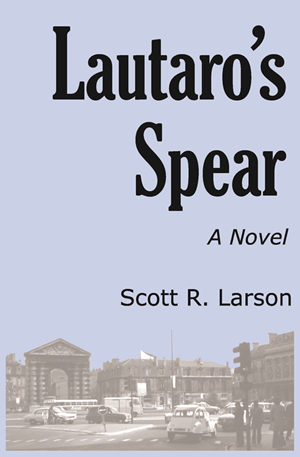
A legendary reclusive filmmaker. An enigmatic cook and restaurant proprietor, who is clearly more than he seems. Two mysterious deliveries to be made behind the Iron Curtain. A desperate search for a long-missing old friend. An unexpected love affair on the coast of Normandy. Dallas Green’s life has only gotten more interesting in the years since his wild youthful adventure in Mexico, as told in the novel Maximilian and Carlotta Are Dead. In the year 1980, he is now a photographer, living and working in San Francisco, where he adjusts to a world very different from that of his rural roots. He may be older, but that does not necessarily mean he is any wiser, as his continuing romantic misadventures attest. Lautaro’s Spear is Scott R. Larson’s third book, following the fantasy novel The Three Towers of Afranor.
—Blurb on various web sites that are, or will soon be, selling my new book
Yes, this means that another book is done and dusted. Officially, the release date is September 29, but I see the Kindle version is available already from Amazon’s US site. Other digital and paper versions should follow shortly. Links to the various sellers around the globe will be updated on my book blog, so check there if you are interested.

Lautaro’s Spear
Unlike the last book, this one takes place in the real world. Well, at least in a world as real as what goes on inside my head. The year is 1980, and the action moves from San Francisco to France to Germany and back again. This is a sequel to Maximilian and Carlotta Are Dead and follows the progress of that book’s misguided teenaged protagonist, Dallas Green, a few years later, as he negotiates his late twenties.

I sometimes regret making Dallas the narrator of these books. It is actually a lot of work to write in character for nearly 300 pages while, at the same time, keeping the prose halfway readable. The reason I wrote the original novel in the first person was that I saw the book as my own personal Huckleberry Finn. If Mark Twain could write in Huck’s dialect, well, then I could write in Dallas’s. Instead of a raft on the Mississippi, Dallas and his friend Lonnie explored the world from the vantage point of a ’65 Chevy traveling the roads of California and Mexico. In the new book, Dallas goes on another journey, but he is a bit older and, hopefully, wiser—although not that much wiser. He is still a bit innocent, so he can also be compared to another seminal literary character, Voltaire’s Candide. He is something of a blank slate when it comes to politics, and he finds himself a bit out of his depth as he wanders into different political and social environments.

For some readers of a certain age, I suppose it will be an exercise in nostalgia. For younger ones, I flatter myself in thinking it might be some sort of history lesson.

I hate it when writers try to impose their opinions about current events onto some past era, although I understand it is a very hard temptation to resist. Writing about America in the 1980s, I could have easily have been lured into drawing parallels between that year’s presidential election and the one that occurred last year—if only I could have actually made heads or tails out of what happened last year. The comparisons, though, wrote themselves anyway. History now looks back at Ronald Reagan very differently from the way many people now look at Donald Trump yet, before he was elected, Reagan was seen by many as quite scary and his election came as a genuine surprise. This is not to say that Reagan and Trump are by any means similar human beings or that Trump will ultimately be seen as successful as Reagan was, but it is worth trying to keep some long-term perspective while in the middle of day-to-day political passions.

If there is a political theme running beneath the surface of my novel, it is the way people tend to divide themselves politically, sometimes with disastrous consquences. Dallas’s journey not only involves the late 20th century culture wars in America but also the residual rift in Europe after World War II and how political divisions in South America led to horrible violence.

Well, look at me, trying to make my silly old book sound profound. I hope some interesting insights did slip into the story but, in the end, my tale is ultimately about how we—mainly young men—get into all kinds of devilment out of boredom, confusion, and just trying to make some sort of sense of this crazy world.

Tuesday, June 20, 2017

Autoimmune Response

“ ‘Washington Post’ Reporter Frustrated Every Space In Parking Garage Taken Up By Anonymous Source”
 —Headline from The Onion, May 30
The improbable rise and election of Donald Trump has flummoxed people so badly that they struggle to find some comparable historical figure to help make sense of him. Quite a few of the more excitable ones quickly reached for the almost-always-inadvisable Hitler comparison, as well as fascists like Benito Mussolini. Some went for Argentina’s populist crook Juan Perón. Others likened President Trump to his putative bromance partner Vladimir Putin. I myself wrote in this blog of a potential similarity to Italy’s buffoonish media magnate Silvio Berlusconi.

Lately another comparison has occurred to me, and I am confident few others have thought of it—Chile’s Salvador Allende. Sounds nuts, right? Politically, two men could not be further apart. If you have any admiration at all for one of them, you will certainly have no time at all for the other.

The late Chilean president has been on my mind because my novel authoring efforts have again transported me back to South America in the early 1970s. (Yes, I have indeed seized upon a topic that allows me to plug my available-real-soon-now third book.) Events of that era in Chile figured into the plot of my first novel, Maximilian and Carlotta Are Dead. They figure even more prominently in the sequel, which follows the further adventures of twentysomething Californian Dallas Green, who insists he is not interested in politics but keeps getting drawn into political situations anyway.

Indulge me with this Trump/Allende thing. First, let’s note the stark differences between them. Allende was a veteran politician and the head of a well-established political party, which was the Socialist Party. Trump is a businessman whose political views over time have been all over the map. His first ever elective office was president of the United States. He was elected on a platform that was pro-business and nationalistic. Allende, as a self-avowed Marxist, was very much into state control of the economy and spoke the language of international solidarity. The two are clearly poles apart ideologically—and that assumes Trump even has a real ideology.

So why do I see a correlation between the two? For one thing, both were presidents elected legally but by electoral minorities. Allende received just 36.6 percent of the popular vote, a slight purality ahead of Jorge Alessandri, the conservative independent candidate, who received 35.3 percent. The Chilean Congress functioned as an effective Electoral College, and the centrist Christian Democrats threw their votes to Allende. They came to regret that strategy. Nearly three years later they joined the rest of the political opposition to declare Allende’s presidency illegal. As for Trump, he of course won the Electoral College despite receiving only 46.1 percent of the popular vote.

In another parallel, both Allende and Trump caused alarm by perceived ties to foreign leaders. In Allende’s case, he was well known to be a personal friend of Fidel Castro. He was photographed several times holding an AK-47 Castro had given him as a gift. When the military came to oust him, he used that weapon to take his own life. (For years his supporters insisted he had been murdered, but eventually his family conceded that he had died by his own hand.) In Trump’s case, many observers were puzzled—if not outright unnerved—by the fact he was given to praising Vladimir Putin’s leadership and did not subject the Russian leader to the same outbursts he directed at most other world leaders. This hysteria continued to the point where Trump’s former campaign is being examined with an eye to possible collusion with the Russians and Trump himself has been reported to be a target for his possible interference.

The fundamental similarity between Trump and Allende is that each, in his own way, represented a threat to his society’s establishment. In Chile’s case, the conservative establishment—with support from the U.S. government—resisted him at every turn. Things reached a crisis when Congress condemned Allende for disregarding judicial rulings, ruling by decree, unlawfully confiscating land, and allowing his supporters to arm themselves while others were not so allowed. Three weeks later the military removed him and took control of the country.

In the current American case, it is the modern liberal establishment that cannot abide Trump. Talk of impeachment began before he was even inaugurated. From the outset, his administration has been undermined by a tide of leaks, not only from his own staff but from intelligence and law enforcement agencies. The leaking campaign extended as high as then-FBI director James Comey, who acknowledged in testimoney before Congress that he had leaked his version of a conversation with Trump with the (successful) intention of triggering a special counsel investigation. That investigation is headed by Comey’s personal friend and longtime colleague Robert Mueller. He has a sterling reputation, not unlike Comey’s, although Comey’s has suffered some since his recent testimony, where he came off more as an insider schemer than the boy scout had seemed before. As for Mueller, some are now looking askance at the fact that his hires for the probe are tending heavily toward those on record for having donated generously to Democratic candidates and political action committees. Moreover, the investigation is unusual in that, as far as I can remember anyway, it is the first one which is trying to establish whether a crime was actually committed as opposed to investigating a crime that has already been established as having been committed.

If there is one overriding similarity between Allende and Trump, it is that their presidencies both evoke the image of a foreign organism pushing its way into the body politic like a pathogen, causing a furious reaction from antibodies trying to ward off the infection. In Allende’s case, it was conservative society, businesses and the military that reacted. In Trump’s case, it is the Democratic party, the corporate media and, most of all, the legions of entrenched career government employees to whom some refer as the “deep state.”

What seems to be forgotten in the heated political environment is that, in a democracy, the political leader you revile was put there by millions of people. Allende may have been a threat to Chilean democracy, but he was supported by a large segment of the population. Many of his supporters wound up being imprisoned, tortured, killed or forced into exile.

What has gotten precious little acknowledgement since the U.S. election is the fact that nearly 63 million people voted for Donald Trump. Those voters had not seen their most serious concerns, fears and problems recognized and treated seriously by politicians of either major party. Rightly or wrongly, they tried to send a message by electing a president opposed by the establishments of both parties. If they turn on the news or pick up a newspaper—and who knows how many of them even bother anymore—what do they see?

Maybe some number of them read the president’s tweets and/or blogs sympathetic to him and still urge him on. Those who do not, on the other hand, must see little sign that their message in November was received or taken to heart by anyone in Washington or the corporate media.

Thursday, March 30, 2017

Divided We Flail

“As The Times begins a period of self-reflection, I hope its editors will think hard about the half of America the paper too seldom covers. The red state America campaign coverage that rang the loudest in news coverage grew out of Trump rallies, and it often amplified the voices of the most hateful. One especially compelling video produced with footage collected over months on the campaign trail, captured the ugly vitriol like few others. That’s important coverage. But it and pieces like it drowned out the kind of agenda-free, deep narratives that could have taken Times readers deeper into the lives and values of the people who just elected the next president.”
New York Times public editor Liz Spayd, shortly after Donald Trump’s election
As I mentioned recently on my book blog, I have finished the first draft of my third novel. Writing a book leaves precious little time for blogging, but maybe that is just as well. With the way the world is going, it is hard to find much useful to say anyway.

The new book is not meant to be particularly political, but certain observations do creep in. It takes place in the year 1980, which means I have been revisiting that momentous period a lot in my head. Much happened during that year. In the course of the story certain events or situations, which are going on in the backround, keep getting referenced. Taken together these background events weave a running theme of how groups of people within a society become estranged from each other.

The protagonist is once again Dallas Green, narrator of my first book Maximilian and Carlotta Are Dead. At 27 he is older but not necessarily much wiser. One faraway event that comes to his attention is the referendum in Chile that year to replace the country’s constitution 55-year-old constitution with one crafted by the Pinochet regime. Dallas also winds up visiting the divided city of Berlin as it enters the final decade of the Cold War. Back home, meanwhile, the United States is going through an election campaign that, in some ways, has future echoes of the one we all lived through last year. On a visit back to his hometown, shortly after the November election, Dallas ponders that people can become so divided despite being citizens of the same country. It is one thing to become passionate over whether the Democrat or the Repubican wins. How do things in other countries actually get to a point where one side takes over the government by violence? Or a city actually has to have a wall built through its heart to separate citizens of the same country?

A novel cannot hope to answer such questions—especially when politicians and social scientists who spend a lot of time thinking about these things do not seem to have a clue. This is definitely a job much better left to clever bloggers. (Yes, that was sarcasm.)

To answer my own question, Germany became divided at the end of World War II mainly because of external forces that were unleashed by the German government’s own tragic behavior. In America, certain rabid partisans on one side or the other have been awfully quick to invoke the Hilter label when it comes to each of the two most recent presidents. While it is always a good idea to be on the lookout for potential abuse of power by a national leader, in both of the recent U.S. administrations the opposition’s bandying of “Hitler” and “fascist” has only served to make the political discourse nonsensical. Unless I am grievously mistaken, the United States is a long ways from becoming Nazi Germany. Chile, on the other hand, is a more worrying comparison.

The fracture of Chilean society, unlike that of Germany, did not come about because of a leader’s deranged visions of conquest and racial purity. The Popular Unity allowed its socialist vision to become so overpowering that it ignored the country’s constitution and invited external support from Cuba’s Castro dictatorship. It anticipated a response from their country’s own military and armed itself in preparation. Even more devastatingly, that military reaction materialized and was supported by a portion of Chilean society that saw violence as being justified to stop the leftist takeover of the country. As a result, many people were imprisoned, tortured, killed or simply disappeared. All these years later, the divisions are still there, but it is remarkable how well the rift has healed 47 years after the election of Allende, 44 years after the military coup that toppled him and 29 years after the plebiscite that restored democracy.

Despite my serious misgivings about President Trump, I do not actually worry that whole groups of people will be rounded up and loaded on trains and sent to concentration camps. Or that the country will become internally militarized and that America’s borders will be fortified to keep people inside the country (as opposed to outside). I am saving my panic for the moment when he actually imprisons judges who thwart his executive orders—as opposed to merely complaining and tweeting about them. I do, however, worry that the country is becoming increasingly divided into two (actually more than two) camps where each side has its own particular view of reality which demonizes people on the other side. People seem increasingly to be talking past one another with no common set of terms or facts. It nearly feels as though we are at a point where the sides are not even debating each other. Instead, each side is having its own isolated debate with a straw man of its own creation.

What is the point of a blogger—even a clever one—trying to raise points to provoke thought when most people out there seem only to be looking for phrases and talking points that bolster their already established world view? In this environment, spinning yarns of fiction definitely feels like a more worthwhile use of time than trying to comment on political reality.

Thursday, July 21, 2016

Drôle de Coup

“More than 50,000 state employees have been rounded up, sacked or suspended in the days since the coup attempt. On Wednesday, 99 top military officers were charged in connection with the events of the weekend. Officials continued to take action against university and school employees, shutting down educational establishments, banning foreign travel for academics and forcing university heads of faculty to resign.”
—BBC News report, today
It is hard to get away from seeing the world and politics through the prism of Game of Thrones, as I alluded to a couple of weeks ago. More and more—and like a lot of people, I suspect—I find myself looking around and not even finding a choice between bad and worse. It is more of a choice between different kinds of worsts. As so often happens while watching the celebrated HBO series, I find myself disinterested in taking sides. As some U.S. government official was reported to have quipped during the protracted Iran-Iraq war of the 1980s, are we allowed to root against both sides? You may think I am speaking primarily of the current American presidential campaign—and that is definitely on my mind—but at the moment I am thinking about Turkey.

It has been a while since we have had such a classic military coup d’état (or attempt at one) in such a strategic country. As we watched it unfold in real time on satellite news channels, I could not help but travel back in time to the coup with which I am most familiar.

In 1973 there was not the 24/7 live coverage of the golpe de estado that unseated and resulted in the death of Salvador Allende in Chile. In those days I learned about it by word of mouth on the campus in France where I was studying and eventually by reading news articles days after the fact. It all seemed very far away and remote from my own personal life. Little did I dream that, three and a half years later, I would be living in Chile and well on my way to having a personally comprehensive understanding of the details of the event and its aftermath. (I have written several blog posts about my time in Chile, beginning with this one.) I heard many first-hand accounts of the coup—mainly from coup supporters at first but increasingly from others as I managed to gain their trust. And I have read quite a bit about it in the years since.

The recent Turkish coup makes interesting comparison to the 1973 Chilean one. It is easy—probably too easy—to imagine that Chile’s history is what Turkey would have experienced if the July 15 coup attempt had succeeded. Conversely, I cannot help but wonder if what Turkey is experiencing today is an indicator of what Chile would have gone through if Allende had prevailed against the military.

The political left’s narrative about Allende and Chile has always highlighted the fact that he was democratically elected. The narrative further posits that he was working arduously to alleviate poverty and to improve people’s lives generally. This version conveniently skips over the fact that he was increasingly ignoring the country’s constitution, was arming a private force controlled by his Socialist Party and was working closely with the repressive Castro regime in Cuba. It is a fair question whether he would have relinquished power at the end of his term. Still, when it comes to taking sides, the principled position is to condemn the overthrow of a democratically elected government.

The same is true in Turkey. Western governments have been unanimous in condemning the Turkish coup attempt and supporting President Recep Tayyip Erdogan. He was the clear popular choice of Turkish voters during his eleven years as prime minister and in the 2014 presidential election. How could a principled observer not support him? And yet. The coup was carried out with so much incompetence that it defies credulity. Every armchair coup observer knows the first thing you do to take over a government is to capture the head of the government. In this case the vacationing president was left free to go on the net and airwaves to rally his followers. The military uprising was so incompetent that many people are asking seriously if Erdogan himself was behind it to give himself an excuse to assume dictatorial powers. He even called it “a gift from God.”

Sorting out the Turkish situation is complicated by the country’s history. It was actually a military commander, Mustafa Kemal Atatürk, who founded the Turkish republic, after the Ottoman Empire fell during World War I, and made the country a more or less functioning democracy. Erdogan in recent years has increasingly cracked down on his political opponents and been criticized internationally for human rights violations. Even before the coup attempt, he had been limiting the independence of the judiciary. Now he is actually having large numbers of judges arrested.

All of this would be easier to ignore if Turkey were not a member of NATO and a prospective—though probably not anymore—member of the European Union. It also has one of the most formidable militaries in the always volatile Middle East region.

Like so many things we see on TV these days, it is just so difficult to find someone to root for.

Tuesday, June 10, 2014

Fact and Fiction

When I left Chile in the late 1970s, I was consumed with a need to process what I had experienced and what I had thought I had learned. That processing took the form of having chats with friends and by writing. In particular, I wrote a series of articles for my hometown newspaper—which I began during my time abroad and continued after I returned.

But I had an urge to do more. I had been studying literature while in Concepción, and I was flush with enthusiasm for Latin American writers and the art of the novel. As some writers—mainly writers of fiction—like to say, fiction can get at deeper truths that straight journalism cannot. That may be overstating it, but certainly fiction can get at truths differently and can touch different levels of our minds than a simple documented accounting.

In the years after my return to North America, I had it in mind to write a novel about a Latin American country. It would deal with a political situation comparable to Chile’s in the years immediately preceding my time in that country. It would be about a country polarized between two different political cultures and belief systems and about a man who rises to become the leader of that country, thereby causing the level of polarization to rise to the point of violence—making him a martyr. And all of this would be seen through the eyes of a young North American named Thomas Dowd. Clearly, this character was inspired by the journalist/filmmaker Charles Horman, who was seized and subsequently killed during the golpe against Salvador Allende in 1973 and who would be the subject of the 1982 film by Costa-gavras, Missing.

That particular novel never got written. During the ensuing years, I always seemed to have jobs that made heavy demands on my time and mental juices. And, as time passed, my original story idea seemed less interesting. It wasn’t really the ideal vehicle for getting at some of the themes I was really interested in, i.e. the strangely symbiotic yet mutually alienating nature of the culture clash between Anglo America and Latin America and, particularly, the frustration (for the Anglo-Saxon mind anyway) of the persistent ambiguity in the Latin American world. Even though I lived in Chile only a few short years after the Allende presidency and resultant coup, while there I got completely different and contradictory versions of what had actually happened and how things had actually been, depending on whom I talked to.

The ambiguity one experiences by living in a place is in sharp contrast to the narratives spun by people who need to fit events into a political agenda. And in the Pinochet era, Chile was one of those places that got a lot of spinning. A vivid memory of my return to Seattle was a visit to an aunt whom I loved dearly. She was a very well read and very well informed woman, but she never asked me a single question about my time in South America. Instead, she handed me a copy of The New Yorker, which she had been saving, and told me that it had an article about Chile that I should read so I would truly understand the country where I spent the previous year. I found myself trying to tell my friends—especially my politically engaged ones—that Chile was a real place with real people, not a parable to be taught.

So my story idea evolved. Instead of seeing things through the eyes of Thomas Dowd, he would not actually appear in the novel. Instead, his presence would haunt it. The story would be about two acquaintances of his in the small California town he came from. They would be two teenagers looking for escape and who would decide, nearly on an impulse, to head south of the border in 1971 to look for him. We would experience a bit of Latin America through their young, somewhat naive perspective. Their 1965 Chevy would carry them on a journey down pot-holed Mexican roads more or less as Huck and Jim traveled the Mississippi on their raft.

I have finally finished that novel. You can find links to it by clicking here. I had a title for it long before it was completed. It is called Maximilian and Carlotta Are Dead. That was something a friend of mine happened to say once in response to some comment I had made about Mexico, and it stuck in my head. It was not only a nice shorthand for the fact that Latin America is well into its post-imperialism phase but also for the universality of our mortality.


With that mouthful of a title and the above summary of my book’s genesis, I have done my best to make it sound meaningful and profound. The fact is, however, that the book is really a bit of a romp. I gave it every bit of male late-adolescent testosterone that I had left. The characters are not very well behaved and they get into well more than the odd spot of trouble. I indulged myself in a fair amount of guilty pleasure by portraying behavior and attitudes that were politically incorrect even in that time, let alone now.

As I was writing it, the parallels with the current day were striking to me. Issues like border security, immigration, political polarization, privacy concerns and U.S. foreign policy hang over the story’s action—just as they still preoccupy people these days.

Mostly, though, the book turned out to be a cockeyed tribute to my childhood best friend. I want to be clear that the two main characters in the book are definitely not him and me, but a fair amount of his personality—at least as it was in his wayward youth—found its way into the character of Lonnie McKay. And there is more than a bit of our own personal inter-dynamics in the relationship between Lonnie and the narrator. But, sadly, we never went to Mexico together.

After some really bad luck in his life, my friend died last autumn. It’s too bad he never got to read the completed book. He would have gotten a kick out of it and would have given me a hard time over parts of it. But in my more spiritual moments, I think that he was the one giving me the push from the afterlife to finally get it finished.

Thursday, May 15, 2014

Life in the Time of Gabo

“La vida no es la que uno vivió, sino la que uno recuerda, y cómo la recuerda para contarla.”
 —Gabriel García Márquez


Traveling abroad (for me anyway) used to mean constantly keeping one eye alert for a newsagents/tobacconist/kiosk/shop/whatever that sold foreign newspapers. I was always on the lookout for The International Herald Tribune (since renamed The International New York Times) for a bit of recent news from the States and the rest of the world.

But those were the old days. Now I find myself watching for the café, bar or hotel with the sign promising “Free WiFi” so I can use my iPod Touch to refresh all the same myriad news sources I use daily in the comfort of my own home.

So it was that, during our Easter holiday last month in Italy, I kept looking for opportunities to read obituaries and comments on the life of Gabriel García Márquez. I had seen the breaking news alert about his death just before putting the iTouch in airplane mode ahead of the flight for Naples, and the news haunted me from the ruins of Pompeii and Herculaneum to the cliff-hugging road on the Amalfi Coast.

I will not claim to have any particularly meaningful insights into the man himself. I can attest, however, that his work came to be very important to me during a consequential period of my life.

By the time I went to Chile in 1977, I had already completed both a bachelor’s degree and a master’s degree. Because my previous university work had not been done in Chile, however, the University of Concepción limited my selection of courses to undergraduate ones. This meant that, to a large extent, I was repeating coursework I had already done at other universities. It also meant that I was four to seven years older than my classmates.

The Institute of Languages at the University of Concepción in 1977
It was by no means uninteresting, but it wasn’t particularly challenging. Moreover, I was sometimes in the uncomfortable position of being used by the professors to shame the local students. I still remember the annoyed young glances coming my way as a prof would say, “Look how well this North American can write, and Spanish isn’t even his first language.” It was an unfair comparison since I was older and further along in my education than my classmates, although one professor did explain to me privately that her frustration with her students actually had nothing to do with me. She said that Chilean universities were facing a generation which had largely missed out on a viable secondary education because of the disruption and tumult during the presidency of Salvador Allende and subsequent coup and military crackdown.

Being North American led to other odd situations. For example, I got a very strange assignment from a literature professor who happened to be a rabid fan of the American author Joseph Heller. Because I was from the United States, he insisted that my class paper had to be on the novel Catch-22, which meant that I had to read and dissect a book originally written in English but in Spanish translation. In a country that had spawned two Nobel literature laureates (Gabriela Mistral and Pablo Neruda), the last thing I ever expected was to be spending my year in South America studying and writing about a North American writer translated into a foreign language.

The one true academic bright spot was getting permission in the second semester to take a graduate seminar on Latin American literature. There were just two of us working with Professor Rodríguez and, as it happened, the other student had been my teacher the semester before. The seminar topic was García Márquez’s Cien años de soledad (One Hundred Years of Solitude) which, at that point, had been in print for ten years and was already an international classic. In hindsight, the idea of spending four or more months studying and writing about a single book may seem kind of obsessive. But I had already learned that the academic study of literature was nothing if not obsessive—especially when it came to literature in the Spanish language. Texts were routinely scoured for all kinds of meanings and messages—overt, covert, coded, insinuated, what have you—as if we students were characters in a Dan Brown novel tracking down the Holy Grail. It meant that we did not merely read the Colombian’s novel. We lived it and breathed it and bathed in it—day in and day out for week upon week.

It could have been a long few months if I had not cared very much for the book. But as countless other readers have found, there is a reason that García Márquez’s style, like that of many other Latin American writers of the 20th century, is called Magic Realism. The continuous and interweaving stories of the mythical Colombian village of Macondo (based on the author’s own home of Aracataca) were mesmerizing and seductive. The multi-generational epic of the Buendía family with its repeated use of given names had a way of drawing us in and making us see every development in the story as more profound than it probably really was. It had the addictive quality of a really good soap opera. In the end, the draw of the book was the way it could be escapist fantasy and social and political commentary all at one time.

A half-decade later I would return to Concepción on a visit and call on Professor Rodríguez. He would flatter me by recalling the paper I wrote for the seminar and the way I had noticed that the word soledad in the title was comprised of the words sol (sun) and edad (age) and how that could be a clue to the author’s underlying message. I remembered how the book had made such an impression on my classmate that she seriously considered giving the baby she was expecting the name Amaranta, after multiple characters in the novel. In the end she didn’t, but in the letters she later wrote me, when mentioning her daughter, she would parenthetically append an explanatory “ex Amaranta” after her name.

When I made that return visit, the mother of “ex Amaranta” was no longer living in Chile. In a strange way we had changed places. After being her student and then classmate, I had ended up becoming her English tutor. She subsequently moved to the United States. Our paths would cross a few more times over the years. She would wind up living and teaching in my home state of California, while I would wind up living in Europe. But always that book by Gabriel García Márquez would always bind us—that and her seemingly spiritual fascination with certain filmmakers, notably Ettore Scola and Roman Polanski.

In the weeks following García Márquez’s demise, I relived the experience of being immersed in his writing while at the same time being amused by all the arguing over his politics. Yes, he was an unrepentant leftist and an apologist for Cuba’s repressive Castro regime. And yes, I would love to know the real story of why the Peruvian writer Mario Vargas Llosa (whose work may actually better stand the test of time and whose politics certainly will) gave him a black eye very publicly at a movie premiere in 1976. Was it over political differences or was it about the comforting shoulder provided during a tricky time in the Vargas’s marriage?

One of the things I read was by a blogger whom I respect very much. She said that, after enjoying Cien años de soledad years before, she recently picked it up and found it unreadable. That sent a shiver up my spine since I have it, in both Spanish and English, on my iPad waiting for a fresh perusal. Will I risk destroying many fond memories by trying to read it again? It’s a risk I’m willing to take. After all, for me the true beauty in those memories has as much to do with the very real city of Concepción as with the mythical village of Macondo.

Tuesday, March 25, 2014

Land of Dreamers

“The credibility of the organization is in serious question by any credible observer. The record of the OAS in Venezuela is an embarrassment.”
—José Miguel Vivanco, director of the Americas division of Human Rights Watch


In February a 17-year-old girl was attacked and robbed in San Cristóbal, a Venezuelan city on the border with Colombia. It was the kind of unfortunate incident that could and does happen in virtually any city in the world on any given evening. But in San Cristóbal it was the straw that broke the camel’s back.

Since the previous year the city’s University of the Andes’s Botanical Gardens had become overrun by drug dealers and criminals. This was part of a national trend that has resulted in Venezuela having one of the highest crime rates in the world. In San Cristóbal many of the criminals’ victims were students, and they lobbied for better security—in vain. After the February 3 attack, word of it spread and the next day students came out to protest. The police response was to arrest protestors and send them to a detention center hundreds of miles away in a city called Coro, where they were reportedly mistreated.

The student response was more protests—not only in San Cristóbal but across the country, including the capital Caracas. They’ve been going on ever since. Government forces have pushed back with force, using tear gas and water cannons. As of this writing, the reported death toll is 36. The government’s political opponents were quick to jump on the protest bandwagon. The most prominent was 42-year-old politician and economist Leopoldo López, and he was soon put behind bars by the government.

Obviously, the protests are not simply about unhappiness over the crime rate. Under the administrations of the late Hugo Chavez and his successor Nicolás Maduro, oil-rich Venezuela is an economic basket case. Inflation is sky high and shoppers at markets face queues at times numbering more than a thousand. Maduro, who not only lacks his mentor’s charisma (which was always lost on me) but is clearly incompetent, won election to the presidency only narrowly and not without suspicions. And, given the government’s tight control on the media, the election could hardly have been considered very fair in any event.

According to reporting by The Wall Street Journal’s Mary Anastasia O’Grady, the masked thugs on motorcycles who have been inflicting the most harm on the protestors are paramilitaries organized by the Chavista government.

One suspects that the situation in Venezuela would have gotten more worldwide attention if not for the even more dramatic events involving Ukraine. Reporting in the general international press has been sketchy at best. Some reports I have heard paint the student protestors as “middle class” or “conservative,” suggesting a bourgeois-vs.-poor narrative.

A rare high-profile mention of the situation came during the Academy Awards ceremony a few weeks ago when Best Supporting Actor Jared Leto expressed solidarity in his acceptance speech with “the dreamers” in Ukraine and Venezuela. Fellow actors Kevin Spacey and Forest Whitaker later tweeted their criticism of the Venezuelan government. Previously vocal Hollywood supporters of Chavez—Sean Penn, Danny Glover, Michael Moore—stayed silent. A photo showing Penn—who has deservedly earned praise for his relief work in Haiti—holding a sign in Spanish supporting Maduro showed up on Twitter, but it was pretty obvious that it had been composed à la Photoshop. More significant was criticism from musicians Willie Colón and, especially, Rubén Blades, whose political activist credentials are impeccable. Clearly stung, Maduro insisted on television that Blades had been misled by fascists. According to none other than Madonna (in a February tweet), “Fascism is alive and thriving in Venezuela” and “Maduro is not familiar with the phrase ‘Human Rights’!”

Events in Venezuela have divided Latin American countries. The protests have been ignored by the Organization of American States, which met in Washington on Friday. In an unusual move, Panama made Venezuelan opposition lawmaker María Corina Machado a temporary member of its delegation so that she could address the body, but delegates voted not to include her in the formal agenda. After hours of arguing, she was finally allowed to speak briefly in an ad hoc capacity. The delegates also took the unusual step, in a 22-to-11 vote, of barring the media from the session. The U.S., Canada, Mexico, Guatemala, Panama, Peru, Honduras, Costa Rica, Colombia, Paraguay and Chile supported her appearance. Brazil, Bolivia, Nicaragua, Ecuador, Argentina and various Caribbean countries joined Venezuela in opposition. Her plea for a resolution demanding that Venezuela release its political prisoners and respect freedom of speech went nowhere. Machado’s supporters fear that she could face arrest after her return to Venezuela.

Brazil’s rebuke of Machado apparently reflects the fact that Brazil is heavily invested in the Venezuelan economy. But it is a sad irony, given that Brazilian president Dilma Rousseff herself was once a student leader who stood up to authority and who, as a result, was tortured by her country’s military.

In the end, a lot of people choose sides based on ideology rather than on respect for democracy or human rights. That is how yesterday’s firebrand who used to fight authority can, later in life, become the defender of authority that abuses its power.

If you find that thought as depressing as I do, then you may take some pleasure from the YouTube video on this page of the Peruvian newspaper El Comercio. Filmed last week at a debate at the Pontifical Catholic University of Chile in Santiago, it went viral in South America. A young Venezuelan woman is applauded by the audience when she tears into leftist Senator Alejandro Navarro, a defender of the Chavista regime. After telling of a journalist friend who was threatened for writing about the government, she yells at the senator, “Go live in Venezuela. I give it to you, I give you my home.”

Even if you don’t understand Spanish, her body language says it all.

Monday, October 7, 2013

Tyrants, Major and Petty

I am nowhere near the point of packing a survival kit and a gun (if I had one) and high-tailing it for the back country. But I do have a healthy nervousness about the size and power of government.

That is not the same thing as having something against people who happen to be employed by the government. The fact is that governments provide many services that are necessary or desirable for our quality of life. And I also understand that many government employees are dedicated professionals who do their best and not always under easy conditions. And in the case of those on the front lines, like police and firefighters, some actually expected to put their lives at risk to protect others.

But I have to admit to a certain amount of nervousness about all the information collected by agencies like the NSA and about abuses of power by the Internal Revenue Service. And, yes, I’m a bit nervous about the centralized government-run information system being built with the aim of accumulating medical information on every person in the country.

This nervousness isn’t born of small things like the inconvenience of waiting in a long queue at the driver’s license office or from the headaches involved in filing a tax return. It comes from reading things like history books and the writings of Franz Kafka. It also comes partly from dealing with bureaucrats and authorities in the various countries where I’ve lived over the years and from hearing the horror stories from others in those countries.

Free and democratic elections and an unfettered and skeptical press are indispensable for keeping a government’s powers in check. I’ve only lived in one place where the government’s power was not held in check. That was in Pinochet’s Chile in the 1970s.

As a foreign student who was sponsored by a well-established international organization and who was intent on having no political involvement, I did not feel particularly at risk while there. In fact, as I’ve written before, because of the strict regime of military law and order I actually felt personally safer there than in other countries. But in minor ways I did experience the effects of a government that was unchecked.

I was reminded of this recently when I happened to read of the suicide of General Odlanier Mena. During the year I lived in Chile, he took over the benignly named National Information Center (CNI). This replaced the National Intelligence Directorate (DINA), which had been established by Pinochet in 1974. The change had to do partly with the fact that, in the years immediately following the military coup that ousted Salvador Allende, the DINA had acquired a sinister reputation. Not only did it gather and keep information on citizens but it also had a paramilitary wing and secret police force that were associated with disappearances and torture. The CNI, if anything, wielded even more power than the DINA since it also had significant judicial powers.

General Mena ran the CNI from 1977 to 1980. Five years ago his retirement was interrupted when he was tried and convicted because of his role in the killing of three leftists shortly after the coup in 1973 while he was commander of an army regiment in Arica, near the Bolivian border.

The general had been serving his sentence at the Cordillera Detention Center in Santiago, a facility where inmates received preferential treatment. According to The New York Times, Cordillera’s ten inmates—which included Mena’s predecessor, Manuel Contreras Sepúlveda, and other DINA and CNI commanders—lived “in five cabins—each with a private bathroom—on grounds that include a tennis court.” The English-language Santiago Times described Cordillera as “luxurious.”

Mena had recently learned that he would be transferred to a less plush prison because of a decision by President Sebastián Piñera to close the Cordillera facility. During a weekend leave at his home, the 87-year-old prisoner shot himself in the head with his own gun, which was registered to him as “a collector’s item.”

I am sure there are many who feel that Mena and his colleagues got off way too easy. But, beyond the fact that they were eventually convicted of committing murders, there also seems to be at least some kind of cosmic justice in the fact that these men in charge of making other people’s lives hell have been spending the end of their lives as the unwilling guests of government functionaries.

Personally, I had only one brush with the CNI. It came at the end of my year in Chile. To leave the country I had to acquire an exit visa. That required an interview with the CNI. Mostly, they wanted to make sure that I didn’t owe any unpaid taxes, but there really wasn’t a limit on whatever else they wanted to delve into. As I nervously sat down for my interview, four framed photographs of the members of the military junta looked down at me from behind my interrogator.

It turned out there was a hitch, as I have previously written. Weeks earlier a border official had refused to stamp my passport when I had entered Chile from Argentina. For a couple of uncomfortable days, it looked as though I might wind up a prisoner of some kind of bureaucratic nightmare.

When it was finally sorted out, I had a good laugh over how silly the government was with all its rules and its slavish attention to forms and stamps and having all the right signatures. I could afford to laugh because, after all, I was never really in any danger of being locked up with no hope of release. There were plenty of others who were not so lucky.

Still, the experience was nerve-wracking enough that I have never since lost my sense of foreboding when it comes to the power of bureaucrats sitting behind desks who do not answer to anybody other than a chain of command that is unbothered by democratic institutions.

Even when they ostensibly answer to an elected government, bureaucrats can still wield their bit of arbitrary power over you when you are in the uncomfortable position of needing them to use their stamp or signing pen.