This is a cross-posting with my book blog.
Coming up with titles for a book or a story can be either easy or frustrating.
In the case of the first two installments of the Dallas Green trilogy, the titles came fairly easily. In fact, I had the title Maximilian and Carlotta Are Dead in my head for a long time before I seriously tackled the book itself. It was something a good friend of mine quipped during a discussion about Mexico, and it stuck in my head for years. When it came time for the sequel, the idea of Lautaro’s Spear came to me fairly easily, keeping consistency with the mention of major historical figures of Latin America. The third book, though, was a real struggle. I considered all kinds of figures from Irish history and legend but found them all unworkable. I ended up on settling for Searching for Cunégonde, which referenced a fictional character from French literature.
As for the fantasy books, I had had The Three Towers of Afranor in my pocket since high school. The Curse of Septimus Bridge was likewise straightforward, and I had the title of that book’s sequel settled (for now anyway) before I even started writing.
When coming up with titles for books, I try to come up with something that hasn’t been used before and which aspires to being unusual or unique. The goal, which may or may not be misguided, is to have something that would be easy to find in a web search.
Interestingly, coming up with a title for my recent short story proved to be one of the more frustrating experiences in coming with a title. I liked the idea of having a French word in it since one of the two main characters is French. Since the plot essentially consists of a meeting, the word rendezvous lent itself. As a title, though, it is hardly unique. If you search that title on the Internet Movie Database, you find there are no fewer than 150 feature films, short films, TV episodes that have the title Rendezvous, Rendez-Vous, Rendez-vous or some other variation as an original title or alternative (e.g. foreign language) title. The good news is that titles cannot be copyrighted, so there is nothing to stop writers like me from reusing them. The drawback is the risk of having one’s work overshadowed by a better known one with the same name.
It’s not just films and books that have titles though. Something one may not think about is that political cartoons can have titles. I was reminded of this fairly soon after I released my short story as a small e‑book. One morning I glanced at The Times of London to see a cartoon by Peter Brookes lampooning U.S. Special Envoy for Climate John Kerry’s high-level meeting on climate in Shanghai in mid-April. Provocatively, it portrays Kerry and his Chinese interlocutor meeting cheerfully over the body of a Uighur while power plants belch out smoke in the background. The title is “Climate Change Rendezvous.”
This cartoon is a blatant homage to the famous Evening Standard cartoon by David Low which appeared in September 1939. That one was called simply “Rendezvous,” and in that context the word harkens back to its original meaning (before the French began using it to mean appointment or date): a place for troops to assemble.
Low’s cartoon depicted Adolf Hitler and Joseph Stalin meeting with exaggerated gestures of politeness over the body of a fallen Polish soldier. The cartoon was published 27 days after the signing of the Molotov-Ribbentrop Pact containing a secret protocol dividing Poland into “spheres of influence” between the Soviet Union and Germany; 19 days after Germany invaded Poland; and three days after the Soviets invaded the country. This joint military action was the official beginning of World War II.
It seems harsh to draw a parallel between talks over climate change and a cynical accord to carve up a sovereign nation, but if political cartoonists know anything, it is that subtlety and nuance are not friends to those trying to get a point across in a single image. Also, shock has a certain value when it comes to attracting eyeballs—and hopefully, brains. In the end, the cartoon is not really about climate change.
The plight of the Uighurs, referenced in Brookes’s cartoon, has been ongoing since the region was forcibly incorporated into China in 1930 but has escalated since 2014 when the Chinese government began the internment of more than a million Muslims, mostly Uighurs, in state-sponsored camps. Testimonies have described suppression of religious practices, political indoctrination, forced sterilizations and abortions, and infanticides. Critics have labeled Chinese policy both ethnocide and cultural genocide and have compared it to the Holocaust. So the cartoon’s comparison to the Hitler and Stalin regimes is not that far off after all.
Still, it may be unfair to imply, as the cartoon seems to, a moral equivalence between the U.S. and China, given that the Chinese government bears the responsibility for its brutal treatment of the Uighurs. Still, the suggestion that the U.S. government may be turning something akin to a blind eye to the atrocities in pursuit of a possibly quixotic climate deal with the Chinese is arguably fair comment. A century from now, will history celebrate John Kerry’s efforts at climate negotiation—or will the question loom larger of why the world left Uighur men, women and children to their fate?
That recalls another use of the word rendezvous. Politicians as dissimilar as Franklin Roosevelt and Ronald Reagan have at critical moments memorably invoked a moral crossroads with a common phrase—rendezvous with destiny.
Showing posts with label Maximilian and Carlotta Are Dead. Show all posts
Wednesday, April 28, 2021
Friday, October 2, 2020
Expat Literary Hero
They began to raise their voices.There is something empowering about writing fiction. When you pen a novel, you experience the illusion of being God. You create people. You make them do what you want. You have total control of their fates. You can bestow them with good fortune or you can punish them with senseless tragedy. Their destinies are pretty much literally in your hands.
«Now we have a Fascist dictatorship!»
«Instead of a Communist one!»
People sitting near us looked uncomfortable. As for me, I was becoming, strangely and unexpectedly, aroused.
—Excerpt from Chapter 11 of Searching for Cunégonde
In practice, it doesn’t really feel that way. Characters—even ones you create yourself—have a way of taking on lives of their own. I think most authors have the strange experience of finding they are channeling their characters rather than controlling them. Your own characters sometimes do things you did not plan or want. Events sometimes take a turn you didn’t see coming when you started out.
These are interesting things to ponder but are probably best left for my book blog where I announced this week the publication of my fifth novel Searching for Cunégonde. More pertinent to this space is the fact that, when one writes a story set in a particular time and place, one is generally constrained by real-world events and situations.
The new book continues the adventures of Dallas Green, the protagonist of Maximilian and Carlotta Are Dead and Lautaro’s Spear. More pertinent to this space is the background provided by the real world to his story. In all three books, he is a picaresque hero journeying through the strange world in which he finds himself. The first novel was set in 1971, the time of the Vietnam War, the military draft in the U.S., and political unrest in Central America. The second book took place in 1980, the year of a U.S. presidential campaign, Ronald Reagan’s election, the sixth Deauville American Film Festival, and a constitutional referendum in Chile.
The new tome splits its narrative mainly between two different time periods. One strand picks up directly after the end of Lautaro’s Spear in December 1980 and proceeds through the following year. These bits alternate with events in the year 1993. This larger scope allowed me to draw in all sorts of historical references. Dallas experiences several weeks of comfortable living under the Pinochet dictatorship as well as venturing into Argentina, also governed by a military junta. There is then a return to California which not only provides a contrast between South and North America but also an implicit comparison between the rural San Joaquin Valley and the suburbs of the Bay Area. Indeed there are a number of contrasts drawn in this story, for example two very different funerals in two very distinct cultures.
By the time this leg of Dallas’s journey ends, he has become all too acquainted with the violent latter days of Ireland’s Troubles. He has also become a nearly unwitting participant in the bad old days of the Cold War, and he even gets to witness the single most symbolic moment of the fall of Communism.
If I have made Dallas’s exploits sound as if they are all about politics, then I have misled you. In this book, as in the others, the heart of the story is really in the friendships. There is some romance as well, or at least as much romance as a neo-Lost-Generation baby-boomer can manage in a cynical world. He finds himself in bed with an interesting array of lovers and not-quite lovers.
At one point someone compares him to the hero of Voltaire’s Candide, thus tipping my hand. That is how I have always seen him—someone more or less politically innocent, wandering the world with wide eyes and bearing witness to the strangeness and wonder of the wider world.
Appropriately enough for this blog, in the course of this novel Dallas becomes an expat. I tried to capture at least a bit of the disorientation that comes with adjusting to a different culture and functioning in a different language. In the end, though, the goal was always to entertain. Mainly to entertain myself, but in the hope that others might be inadvertently entertained as well.
The paperback edition of Searching for Cunégonde is available from major online booksellers, including Amazon and Barnes and Noble. The digital version is available from Amazon’s Kindle store, Barnes and Noble’s Nook store, Kobo, Google Play and Apple iBooks. For those links and other information, kindly consult my book blog.
Wednesday, September 27, 2017
Looking Back, Literarily
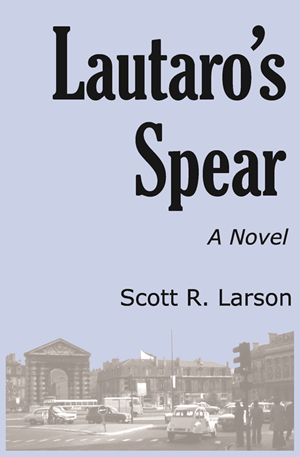
A legendary reclusive filmmaker. An enigmatic cook and restaurant proprietor, who is clearly more than he seems. Two mysterious deliveries to be made behind the Iron Curtain. A desperate search for a long-missing old friend. An unexpected love affair on the coast of Normandy. Dallas Green’s life has only gotten more interesting in the years since his wild youthful adventure in Mexico, as told in the novel Maximilian and Carlotta Are Dead. In the year 1980, he is now a photographer, living and working in San Francisco, where he adjusts to a world very different from that of his rural roots. He may be older, but that does not necessarily mean he is any wiser, as his continuing romantic misadventures attest. Lautaro’s Spear is Scott R. Larson’s third book, following the fantasy novel The Three Towers of Afranor.Yes, this means that another book is done and dusted. Officially, the release date is September 29, but I see the Kindle version is available already from Amazon’s US site. Other digital and paper versions should follow shortly. Links to the various sellers around the globe will be updated on my book blog, so check there if you are interested.
—Blurb on various web sites that are, or will soon be, selling my new book

Unlike the last book, this one takes place in the real world. Well, at least in a world as real as what goes on inside my head. The year is 1980, and the action moves from San Francisco to France to Germany and back again. This is a sequel to Maximilian and Carlotta Are Dead and follows the progress of that book’s misguided teenaged protagonist, Dallas Green, a few years later, as he negotiates his late twenties.
I sometimes regret making Dallas the narrator of these books. It is actually a lot of work to write in character for nearly 300 pages while, at the same time, keeping the prose halfway readable. The reason I wrote the original novel in the first person was that I saw the book as my own personal Huckleberry Finn. If Mark Twain could write in Huck’s dialect, well, then I could write in Dallas’s. Instead of a raft on the Mississippi, Dallas and his friend Lonnie explored the world from the vantage point of a ’65 Chevy traveling the roads of California and Mexico. In the new book, Dallas goes on another journey, but he is a bit older and, hopefully, wiser—although not that much wiser. He is still a bit innocent, so he can also be compared to another seminal literary character, Voltaire’s Candide. He is something of a blank slate when it comes to politics, and he finds himself a bit out of his depth as he wanders into different political and social environments.
For some readers of a certain age, I suppose it will be an exercise in nostalgia. For younger ones, I flatter myself in thinking it might be some sort of history lesson.
I hate it when writers try to impose their opinions about current events onto some past era, although I understand it is a very hard temptation to resist. Writing about America in the 1980s, I could have easily have been lured into drawing parallels between that year’s presidential election and the one that occurred last year—if only I could have actually made heads or tails out of what happened last year. The comparisons, though, wrote themselves anyway. History now looks back at Ronald Reagan very differently from the way many people now look at Donald Trump yet, before he was elected, Reagan was seen by many as quite scary and his election came as a genuine surprise. This is not to say that Reagan and Trump are by any means similar human beings or that Trump will ultimately be seen as successful as Reagan was, but it is worth trying to keep some long-term perspective while in the middle of day-to-day political passions.
If there is a political theme running beneath the surface of my novel, it is the way people tend to divide themselves politically, sometimes with disastrous consquences. Dallas’s journey not only involves the late 20th century culture wars in America but also the residual rift in Europe after World War II and how political divisions in South America led to horrible violence.
Well, look at me, trying to make my silly old book sound profound. I hope some interesting insights did slip into the story but, in the end, my tale is ultimately about how we—mainly young men—get into all kinds of devilment out of boredom, confusion, and just trying to make some sort of sense of this crazy world.
Tuesday, June 20, 2017
Autoimmune Response
“ ‘Washington Post’ Reporter Frustrated Every Space In Parking Garage Taken Up By Anonymous Source”The improbable rise and election of Donald Trump has flummoxed people so badly that they struggle to find some comparable historical figure to help make sense of him. Quite a few of the more excitable ones quickly reached for the almost-always-inadvisable Hitler comparison, as well as fascists like Benito Mussolini. Some went for Argentina’s populist crook Juan Perón. Others likened President Trump to his putative bromance partner Vladimir Putin. I myself wrote in this blog of a potential similarity to Italy’s buffoonish media magnate Silvio Berlusconi.
—Headline from The Onion, May 30
Lately another comparison has occurred to me, and I am confident few others have thought of it—Chile’s Salvador Allende. Sounds nuts, right? Politically, two men could not be further apart. If you have any admiration at all for one of them, you will certainly have no time at all for the other.
The late Chilean president has been on my mind because my novel authoring efforts have again transported me back to South America in the early 1970s. (Yes, I have indeed seized upon a topic that allows me to plug my available-real-soon-now third book.) Events of that era in Chile figured into the plot of my first novel, Maximilian and Carlotta Are Dead. They figure even more prominently in the sequel, which follows the further adventures of twentysomething Californian Dallas Green, who insists he is not interested in politics but keeps getting drawn into political situations anyway.
Indulge me with this Trump/Allende thing. First, let’s note the stark differences between them. Allende was a veteran politician and the head of a well-established political party, which was the Socialist Party. Trump is a businessman whose political views over time have been all over the map. His first ever elective office was president of the United States. He was elected on a platform that was pro-business and nationalistic. Allende, as a self-avowed Marxist, was very much into state control of the economy and spoke the language of international solidarity. The two are clearly poles apart ideologically—and that assumes Trump even has a real ideology.
So why do I see a correlation between the two? For one thing, both were presidents elected legally but by electoral minorities. Allende received just 36.6 percent of the popular vote, a slight purality ahead of Jorge Alessandri, the conservative independent candidate, who received 35.3 percent. The Chilean Congress functioned as an effective Electoral College, and the centrist Christian Democrats threw their votes to Allende. They came to regret that strategy. Nearly three years later they joined the rest of the political opposition to declare Allende’s presidency illegal. As for Trump, he of course won the Electoral College despite receiving only 46.1 percent of the popular vote.
In another parallel, both Allende and Trump caused alarm by perceived ties to foreign leaders. In Allende’s case, he was well known to be a personal friend of Fidel Castro. He was photographed several times holding an AK-47 Castro had given him as a gift. When the military came to oust him, he used that weapon to take his own life. (For years his supporters insisted he had been murdered, but eventually his family conceded that he had died by his own hand.) In Trump’s case, many observers were puzzled—if not outright unnerved—by the fact he was given to praising Vladimir Putin’s leadership and did not subject the Russian leader to the same outbursts he directed at most other world leaders. This hysteria continued to the point where Trump’s former campaign is being examined with an eye to possible collusion with the Russians and Trump himself has been reported to be a target for his possible interference.
The fundamental similarity between Trump and Allende is that each, in his own way, represented a threat to his society’s establishment. In Chile’s case, the conservative establishment—with support from the U.S. government—resisted him at every turn. Things reached a crisis when Congress condemned Allende for disregarding judicial rulings, ruling by decree, unlawfully confiscating land, and allowing his supporters to arm themselves while others were not so allowed. Three weeks later the military removed him and took control of the country.
In the current American case, it is the modern liberal establishment that cannot abide Trump. Talk of impeachment began before he was even inaugurated. From the outset, his administration has been undermined by a tide of leaks, not only from his own staff but from intelligence and law enforcement agencies. The leaking campaign extended as high as then-FBI director James Comey, who acknowledged in testimoney before Congress that he had leaked his version of a conversation with Trump with the (successful) intention of triggering a special counsel investigation. That investigation is headed by Comey’s personal friend and longtime colleague Robert Mueller. He has a sterling reputation, not unlike Comey’s, although Comey’s has suffered some since his recent testimony, where he came off more as an insider schemer than the boy scout had seemed before. As for Mueller, some are now looking askance at the fact that his hires for the probe are tending heavily toward those on record for having donated generously to Democratic candidates and political action committees. Moreover, the investigation is unusual in that, as far as I can remember anyway, it is the first one which is trying to establish whether a crime was actually committed as opposed to investigating a crime that has already been established as having been committed.
If there is one overriding similarity between Allende and Trump, it is that their presidencies both evoke the image of a foreign organism pushing its way into the body politic like a pathogen, causing a furious reaction from antibodies trying to ward off the infection. In Allende’s case, it was conservative society, businesses and the military that reacted. In Trump’s case, it is the Democratic party, the corporate media and, most of all, the legions of entrenched career government employees to whom some refer as the “deep state.”
What seems to be forgotten in the heated political environment is that, in a democracy, the political leader you revile was put there by millions of people. Allende may have been a threat to Chilean democracy, but he was supported by a large segment of the population. Many of his supporters wound up being imprisoned, tortured, killed or forced into exile.
What has gotten precious little acknowledgement since the U.S. election is the fact that nearly 63 million people voted for Donald Trump. Those voters had not seen their most serious concerns, fears and problems recognized and treated seriously by politicians of either major party. Rightly or wrongly, they tried to send a message by electing a president opposed by the establishments of both parties. If they turn on the news or pick up a newspaper—and who knows how many of them even bother anymore—what do they see?
Maybe some number of them read the president’s tweets and/or blogs sympathetic to him and still urge him on. Those who do not, on the other hand, must see little sign that their message in November was received or taken to heart by anyone in Washington or the corporate media.
Labels:
Chile,
Election,
Latin America,
Maximilian and Carlotta Are Dead,
My Novel,
Press
Tuesday, October 14, 2014
Limelight
Just a short note to point those interested to a couple of interviews I have done in regards to my novel, Maximilian and Carlotta Are Dead.
One just went up today and can be found at Limelight Literature. That site is run by Wales-based author and blogger L E Fitzpatrick, and she does a lovely job at highlighting her fellow authors and getting exclusive extracts for readers. I encourage you to read her blog not only for my interview but also to learn a lot about new writers and books.
Another interview has been up for a while at Book Goodies. That’s another great site for learning about new authors out there. Check it out.
Wednesday, September 10, 2014
News on My Book
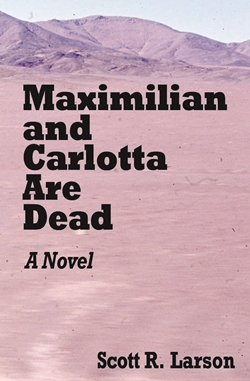
I am excited to announce that my novel Maximilian and Carlotta Are Dead is now available in paperback.
Along with a new format, the book has a new cover.
It was released in Amazon’s Kindle Store in June where, until recently, it was sold exclusively.
It is now available in paperback at Amazon and at Barnes and Noble.
It is also now available in EPUB digital book format from Barnes and Noble’s NOOK Store, Google Play and Kobo Books. And it continues to be available from Amazon’s Kindle Store.
As I wrote here in June, “the book is really a bit of a romp. I gave it every bit of male late-adolescent testosterone that I had left. The characters are not very well behaved and they get into well more than the odd spot of trouble. I indulged myself in a fair amount of guilty pleasure by portraying behavior and attitudes that were politically incorrect even in that time, let alone now.”
Tuesday, June 10, 2014
Fact and Fiction
When I left Chile in the late 1970s, I was consumed with a need to process what I had experienced and what I had thought I had learned. That processing took the form of having chats with friends and by writing. In particular, I wrote a series of articles for my hometown newspaper—which I began during my time abroad and continued after I returned.
But I had an urge to do more. I had been studying literature while in Concepción, and I was flush with enthusiasm for Latin American writers and the art of the novel. As some writers—mainly writers of fiction—like to say, fiction can get at deeper truths that straight journalism cannot. That may be overstating it, but certainly fiction can get at truths differently and can touch different levels of our minds than a simple documented accounting.
In the years after my return to North America, I had it in mind to write a novel about a Latin American country. It would deal with a political situation comparable to Chile’s in the years immediately preceding my time in that country. It would be about a country polarized between two different political cultures and belief systems and about a man who rises to become the leader of that country, thereby causing the level of polarization to rise to the point of violence—making him a martyr. And all of this would be seen through the eyes of a young North American named Thomas Dowd. Clearly, this character was inspired by the journalist/filmmaker Charles Horman, who was seized and subsequently killed during the golpe against Salvador Allende in 1973 and who would be the subject of the 1982 film by Costa-gavras, Missing.
That particular novel never got written. During the ensuing years, I always seemed to have jobs that made heavy demands on my time and mental juices. And, as time passed, my original story idea seemed less interesting. It wasn’t really the ideal vehicle for getting at some of the themes I was really interested in, i.e. the strangely symbiotic yet mutually alienating nature of the culture clash between Anglo America and Latin America and, particularly, the frustration (for the Anglo-Saxon mind anyway) of the persistent ambiguity in the Latin American world. Even though I lived in Chile only a few short years after the Allende presidency and resultant coup, while there I got completely different and contradictory versions of what had actually happened and how things had actually been, depending on whom I talked to.
The ambiguity one experiences by living in a place is in sharp contrast to the narratives spun by people who need to fit events into a political agenda. And in the Pinochet era, Chile was one of those places that got a lot of spinning. A vivid memory of my return to Seattle was a visit to an aunt whom I loved dearly. She was a very well read and very well informed woman, but she never asked me a single question about my time in South America. Instead, she handed me a copy of The New Yorker, which she had been saving, and told me that it had an article about Chile that I should read so I would truly understand the country where I spent the previous year. I found myself trying to tell my friends—especially my politically engaged ones—that Chile was a real place with real people, not a parable to be taught.
So my story idea evolved. Instead of seeing things through the eyes of Thomas Dowd, he would not actually appear in the novel. Instead, his presence would haunt it. The story would be about two acquaintances of his in the small California town he came from. They would be two teenagers looking for escape and who would decide, nearly on an impulse, to head south of the border in 1971 to look for him. We would experience a bit of Latin America through their young, somewhat naive perspective. Their 1965 Chevy would carry them on a journey down pot-holed Mexican roads more or less as Huck and Jim traveled the Mississippi on their raft.
I have finally finished that novel. You can find links to it by clicking here. I had a title for it long before it was completed. It is called Maximilian and Carlotta Are Dead. That was something a friend of mine happened to say once in response to some comment I had made about Mexico, and it stuck in my head. It was not only a nice shorthand for the fact that Latin America is well into its post-imperialism phase but also for the universality of our mortality.
With that mouthful of a title and the above summary of my book’s genesis, I have done my best to make it sound meaningful and profound. The fact is, however, that the book is really a bit of a romp. I gave it every bit of male late-adolescent testosterone that I had left. The characters are not very well behaved and they get into well more than the odd spot of trouble. I indulged myself in a fair amount of guilty pleasure by portraying behavior and attitudes that were politically incorrect even in that time, let alone now.
As I was writing it, the parallels with the current day were striking to me. Issues like border security, immigration, political polarization, privacy concerns and U.S. foreign policy hang over the story’s action—just as they still preoccupy people these days.
Mostly, though, the book turned out to be a cockeyed tribute to my childhood best friend. I want to be clear that the two main characters in the book are definitely not him and me, but a fair amount of his personality—at least as it was in his wayward youth—found its way into the character of Lonnie McKay. And there is more than a bit of our own personal inter-dynamics in the relationship between Lonnie and the narrator. But, sadly, we never went to Mexico together.
After some really bad luck in his life, my friend died last autumn. It’s too bad he never got to read the completed book. He would have gotten a kick out of it and would have given me a hard time over parts of it. But in my more spiritual moments, I think that he was the one giving me the push from the afterlife to finally get it finished.
Subscribe to:
Posts (Atom)