Showing posts with label National Security. Show all posts

Monday, April 11, 2022

History and Context

Our weapons are not weapons with which cities and countries may be destroyed, walls and gates broken down, and human blood shed in torrents like water. But they are weapons with which the spiritual kingdom of the devil is destroyed.
 —Influential Anabaptist religious leader Menno Simons (1496-1561), whose followers were known as Mennonites
Many words have flowed on the war in Ukraine. Given the going price of talk (cheap), allow me to throw in mine for what they’re worth (two cents).

Since my main gig is film blogging, I can begin by recommending two movies. When Russia invaded Ukraine last month, I was at a film festival, specifically the Dublin International Film Festival. By complete coincidence, one of the films I saw there was Elie Grappe’s Olga, a fictional story about a teenage gymnast forced into exile during Ukraine’s Euromaidan protests and Revolution of Dignity during 2013-14. In the movie we see Kyiv as the modern, glistening city it was and, hopefully, will be again. We also get a crash course in how Ukrainians rose up against a corrupt, pro-Russian government and chased it from power. It’s a useful reminder that the current war has a context and that Ukraine has a history that didn’t begin only when the country started showing up daily in our newscasts.

The other movie is one I saw three years ago at the Galway Film Fleadh and which I recently rewatched. It was directed by Oscar-nominated Polish filmmaker Agnieszka Holland and is based on the true story of Welsh journalist Gareth Jones. It is called Mr. Jones after the film’s central character and also after a George Orwell character that may have been inspired by him. The film recounts his journey to Moscow in 1933 where he was determined to learn how Stalin was funding the Soviet Union’s military buildup. On a visit to Ukraine (then part of the USSR), he slipped away from his handlers to see firsthand the devastating famine caused by Stalin’s policy of wheat exports. Such an atrocity was seen as impossible in the minds of other western journalists, who idealistically saw the Soviet Union as the way to the future and to modernity. The most egregious example was The New York Times’s Moscow bureau chief Walter Duranty, who actually won a Pulitzer Prize for articles debunking Jones’s famine accounts, which had appeared in The Times of London. Despite Duranty’s clear journalistic malpractice, his Pulitzer has never been revoked. Jones was kidnapped and murdered in Mongolia in 1935, presumably by the NKVD (Soviet secret police).

Beyond film recommendations, I offer my own strange connection to Ukraine. As far as I know, I have no Ukrainian ancestry, but it so happens that four of my great-grandparents were born in the Zaporizhzhia Oblast region of Ukraine, which is currently under Russian occupation. Several earlier generations were also born there. They were farmers who did not mix much with people outside their own German-speaking community.

They began as a Dutch Anabaptist movement and fled persecution in the Low Countries in the early-to-mid-16th century for Poland’s Vistula Delta region where they were valued for their skill in building dykes. In the mid-to-late-18th century, they were invited by Catherine the Great to settle in what is now Ukraine. This was territory recently won by Russia in a war with the Turkish Ottoman Empire and which had been dubbed New Russia or South Russia. In return, the devoutly pacifist Mennonites were granted special status which, among other things, exempted them from military service. During the reign of Tsar Alexander II in the late 19th century, the government moved to strip the special status, prompting many of them to emigrate elsewhere. Families resettled all over the world, and that is how my maternal grandparents came to be born in Kansas, live for a time in Oklahoma and then finally settle in California’s San Joaquin Valley.

What my family history tells me is that, while Vladimir Putin insists Ukraine is an integral part of Russia, it is actually a conquered territory that Russia has used as a buffer against perceived threats and which Moscow has treated brutally for generations. No wonder so many Ukrainians (though not all, it should be noted) would prefer to be part of the democratic liberal community of Western Europe.

To much fanfare, the European Union has kicked off the long, bureaucratic process of admitting Ukraine as a member. Depending on how events on the ground develop, this could turn out to be farsighted, provocative or merely symbolic. The dilemma for Europeans is whether Ukraine will eventually be seen as a new and shining outpost of Western values or wind up as an unfortunate sacrifice to Russia’s paranoia about its security. Would such a sacrifice even satisfy Putin?

To put it another way, will Ukraine be Finland in 1940 or Hungary in 1956? Or more worryingly, Poland in 1939?

Tuesday, August 17, 2021

Running for the Exit

I think he has been wrong on nearly every major foreign policy and national security issue over the past four decades.
 —Robert Gates, Secretary of Defense under presidents George W. Bush and Barack Obama, writing about Joe Biden in his 2014 book Duty: Memoirs of a Secretary at War

[T]he likelihood there’s going to be the Taliban overrunning everything and owning the whole country is highly unlikely.
 —President Biden, discussing Afghanistan in a press conference on July 8

This is a foreign policy catastrophe, the likes we haven’t seen in decades, I’m afraid, internationally
 —Irish foreign minister Simon Coveney, commenting on the Afghanistan situation in a radio interview on Monday
In the lead-up to the U.S. withdrawal from Afghanistan, there was much media speculation about how much it might, at the end, resemble the country’s chaotic retreat from Vietnam in 1975. As it happened, there were a lot of similarities. From panic at the U.S. embassy, among others, to desperate last-minute crowding at the capital’s airport, there was plenty of fodder for déjà vu for those of us who remember well the fall of Saigon.

For one thing, the endgame was set up by a peace treaty. In the earlier case, it was the Nixon Administration’s pact with North Vietnam, which resulted in a Nobel Peace Prize for Henry Kissinger and Le Duc Tho in 1973. In the current situation, it was the Trump Administration’s agreement with the Taliban a year and a half ago. In both cases, those pieces of paper were tossed aside once a subsequent U.S. administration pulled troops out suddenly. In 1975 it was the Ford Administration, which had little choice after Congress cut off all Vietnam funding. Today it is the Biden Administration, which announced four months ago the drawdown of all U.S. troops from Afghanistan.


One difference between the two situations is the reaction of America’s hard political left.

“Ho Chi Minh puts a lot of hope in our hearts,” declared a woman attending a spontaneous celebration in April 1975. “As we practice the philosophies we believe in we forget that there are other people who believe in the same thing but practice it differently because of their environment. The greater struggle lies ahead.”

Added a war veteran-turned-anti-war-activist, “It’d be so far out to be there right now.” He was referring to the capital of soon-to-be-absorbed South Vietnam, which had just been renamed Ho Chi Minh City.

The above quotes are from a 46-year-old event in Isla Vista, the densely populated student ghetto abutting the Santa Barbara campus of the University of California. They were chronicled in the student newspaper The Nexus, and yes, I was the hack scribe who reported them. A similar event had been held weeks earlier to mark Cambodia’s surrender to the Khmer Rouge.

Some of the people at the April event were there simply to express relief at the final end of the war and the U.S.’s involvement in the region. Others were wholeheartedly celebrating a U.S. defeat at the hands of Communists. For others, the celebratory mood may have been more about something more general: a former colony casting out a Western superpower.

I can’t imagine that very many on the political left today are celebrating the Taliban’s victory. I no longer have the contacts I did during my Seattle days, so I’m not really sure. If any are celebrating, though, it cannot be without mixed feelings. While the new rulers of Afghanistan have done their best to project a more presentable image as their return to power loomed, their track record and unabashed world view suggest their rule will be a disaster for anyone who cares about western liberal democratic values in general or the rights of women and minorities in particular. In my experience, though, the hard left tends to see such rights and social issues not as ends in themselves but mainly as issues to exploit tactically in their ultimate aim: to see the that right people end up in charge.

To be clear, when I talk about the “hard left,” I’m not talking about people who vote for Democrats. My experience with hard-core leftists is that they mainly vote for fringe candidates in protest or, more often, don’t vote at all. If they do vote for a Democrat, it’s usually grudgingly and/or tactically. They do, however, show up en masse at demonstrations and protests, which sometimes results in generating enthusiasm and motivation for Democratic-leaning voters.

While the hard left is definite minority in America, it’s hard not to notice that views once considered on the political fringe have infiltrated the mainstream. A sign of this is the ardent media coverage—both left and right—of the so-called “squad,” a half-dozen Representatives who, according to opinion polls anyway, are well to the left of most Democrats—let alone most Americans.

As for Afghanistan, those of us who have seen this movie before know pretty much what to expect. In North America and Europe there will be reflections and recriminations about how the occupation of the country began and why it turned out the way it did. In Southwest Asia there will be strife and misery and perhaps yet another refugee crisis. (For years after the fall of South Vietnam, waves of so-called “boat people” flooded out of the country.) There will be heartbreaking tales of people, mainly women, whose lives and opportunities will be set back to a previous century. One also has to ask if Taliban-controlled Afghanistan will go back to being a haven and base for international terrorists.

In the last presidential election, we were told a vote for Joe Biden was a vote for returning to normalcy, sanity and competency. Things are definitely back to what’s considered normal in Washington, and I suppose the capital is as sane as it’s ever been—for whatever that’s worth. Competency? Even if you think ending U.S. involvement in Afghanistan was a good idea, you still have to wonder if the terms of withdrawal couldn’t have been negotiated better and whether the actual exit could have been handled more competently.

Watching Biden on countless Sunday morning news programs in the 1990s and 2000s, it was always clear to me he considered himself a foreign policy maven. Yet, to anyone paying attention, it was also clear that his ideas—which were just that, since as a senator or even vice-president he had little discernible influence on actual policy—were always a little off from establishment foreign policy thinking. Whether it was his idea of splitting Iraq into three countries or advising President Obama not to pull the trigger on Osama bin Laden, he always seemed oddly contrarian.

Reportedly, Biden overruled his top military advisers in following through on the Trump Administration’s deal with the Taliban. You have to wonder what that says about his judgment as he faces upcoming crises with places like Iran and North Korea.

Biden’s real strength was always in domestic politics, and that probably tells us more about his handling of Afghanistan than all his years on the Senate Foreign Relations Committee. Apparently, polls said that getting out of Afghanistan ranked as very popular among U.S. voters. If it remains popular after this fiasco—even after heart-wrenching footage of people clinging to taxiing aircraft in Kabul—then maybe the president will have succeeded on his own terms.

Wednesday, June 16, 2021

Bot and Sold

This is a cross-posting with my movie blog.

A funny thing happened on my film blog last month. No, it wasn’t something I wrote—or at least that’s not what I’m talking about anyway.

I have a page where each month I present a few statistics from the previous month. Mostly it’s to get an idea of who is looking at my blog but also to amuse myself. The page features a pie chart showing the various countries from where I am getting hits. Historically, about half the hits are from the United States with the next larger slices from places like the UK, Ireland and Canada. After that the slices get pretty fragmented into a few dozen other countries all over the world. I also list the ten weekly commentaries in my archive that have gotten the most hits. And then just for fun I list five of the most entertaining web searches that have found my site.

When I went to gather the numbers for May, I encountered something that hadn’t happened before. Ninety-seven percent of the hits were from one country, and that country was Indonesia. The U.S. came in second with two percent. Twenty-six other countries were tallied with percentages rounded off to insignificance.

Why did internet users in Indonesia suddenly take an interest in my movie reviews? The answer is that they almost certainly didn’t. Something else was going on. I think the term we’re looking for here is web bots.

While such a massive number of hits from one country is unprecedented for my humble site, this weird kind of bot activity is not. Only very belated did I realize that my site was prowled by Russian bots coming up to the 2016 election. During September, October and November of that year, 11.9 percent of my hits came from Russia (after Ireland at 34.13 percent and the U.S. at 20.45 pecent). That had never happened before. Historically, my hits from Russia had always been nil or negligible. Cluelessly, I just shrugged and thought it must have had something to do with a few movies I had reviewed that were made by an Azerbaijani filmmaker. He had contacted me through a Russian email address (Azerbaijan being a former republic in the USSR), and I figured that he must have just had a lot of friends and relatives checking out my reviews of his films.

It was an embarrassingly long time afterward that it dawned on me that it might have had something to do with the 2016 presidential election. In my defense, I was kind of oblivious to the Russian trolling thing because none of those political bot messages everyone talked about seemed to show up in my Facebook feed. Did you know that hidden in your Facebook settings is a profile page where Facebook displays all the information it think it’s found out about you—things like religion, political preference, etc.? From this I know that Facebook has never been able to figure out what political party I support, and maybe that’s why I somehow avoided all the bot propaganda that I kept hearing about in the wake of President Trump’s election.

When the 2020 election rolled around, I was more savvy, so I kept an eye out for any more bot funny business. Sure enough, the numbers went screwy again. In the period from September to November 2020, the second and third most hits (after the U.S. at 36.09 percent) were from Hong Kong (20.26 percent) and China (7.56 percent), respectively. Nothing like that had ever happened before. Does that mean Chinese bots were working mischief during the election? People who had screamed bloody hell about Russian interference four years earlier did not seem concerned about it anyway. After all, the right candidate had won.

What does it all mean? Beats me. I don’t mind all the extra hits, but it would be nice if, while the bots are at it, they’d click on some of ads and maybe buy something.

We’re definitely in a strange time when it comes to the internet. A few times lately our broadband service has been disrupted by denial-of-service attacks by malicious cyber actors. Also, the entire Irish healthcare system has been forced to go retro because of a ransomware attack (traced by the authorities to Russia) that put its online systems out of commission. That points up the risks in having systems that are overly centralized. There may be other lessons as well. More than one acquaintance who happens to be a nurse has said that they love having the system down. It means a lot less time filling out online forms and more time actually working with patients. It also means fewer statistics on Covid ‑19 cases and death and on progress with vaccinations on the nightly news—something the government may not be all that unhappy about.

Okay, I can understand all the Russian bot activity in 2016 and all the Chinese bot activity in 2020, but what the heck is the deal with Indonesia in May of 2021? That one has me completely confounded. I can only hope the bots are aimed directly at me because one of the characters in my most recent novel Searching for Cunégonde happened to have an Indonesian father.

Thursday, May 21, 2020

Spy Games

“Updated Patriot Act Finally Legalizes 80% Of Current FBI Operations”
  —Headline in The Onion, May 14
Sometimes I think I live in a completely different reality than everyone else. Or maybe I’m the only one who doesn’t have amnesia. Or maybe it’s just that everyone working in the news media is a child with no perspective going back further than his or her recent high school graduation.

The latest thing that has set me off is the reporting on the “unmasking” that has been going on in U.S. government agencies. There are lots of examples of what I am talking about, but let’s pick on an article that appeared in The Washington Post last week. Here is the lead paragraph: “Three Republican senators on Wednesday made public a declassified list of U.S. officials, including former vice president Joe Biden, who made requests that would ultimately ‘unmask’ Trump adviser Michael Flynn in intelligence documents in late 2016 and early 2017—a common government practice but one that some conservatives have seized on to imply wrongdoing.”

Did I miss something? I certainly accept the Post’s assertion that unmasking is “a common government practice,” but when did that happen? More importantly, when did it become an unnoteworthy circumstance in the Post’s journalistic estimation?

Were none of the four reporters credited with working on the article old enough to remember—or at least read about—the huge debate we had over the Patriot Act?

In the wake of the 9/11 attacks, there was understandably a huge spike in the volume of surveillance applications under the Foreign Intelligence Surveillance Act (FISA). As the possible terrorists being monitored were not U.S. citizens, they did not get protections under the U.S. Constitution, but there was concern about the U.S. citizens (incidental capture, as it was termed) that monitored foreigners might be talking to. What about their rights? The solution to this problem was to mask the names of any U.S. citizens that might be picked up. Extremely senior U.S. government officials, however, could unmask those names if there was a demonstrable security concern. In other words, don’t worry, civil libertarians, Americans’ privacy rights are being looked after. Nothing to be paranoid about.

“In 2019,” our Post correspondents inform us nonchalantly in the final paragraph of their article, “the NSA unmasked just over 10,000 U.S. individuals’ identities, a substantial decrease from the previous year, but still more than in the final year of the Obama administration, according to government records.”

Uh, okay. Maybe it’s just me, but that kind of seems like a lot. Remember, they are supposed to be surveilling only non-Americans. There is a whole different process involved when you actually want to surveil U.S. citizens. You’re supposed to get a warrant from a judge.

The Post’s journalistic nonchalance is presumably because this isn’t an article about American civil liberties. It is an article reassuring us not to be concerned about the unmasking that was occurring during the Obama Administration. Nothing to worry about, folks. This stuff happens all the time.

The thing is, even if we accept that, yes, lots of foreigners’ conversations get monitored by our intelligence services, and yes, a lot of Americans get caught up in that monitoring, and sure, thousands of those Americans have their identities revealed even though they are supposed to have constitutional protections from that kind of fishing-expedition type monitoring, someone still needs to explain to me something else.

You see, because there is nothing I can possibly do about it, I pretty much have to accept that my country’s government is doing all this electronic monitoring and is frequently using a back-door to the Constitution to listen in on Americans without keeping it anonymous. All I can do is hope that this is mostly being done by intelligence professionals whose overriding priority is the country’s security. Should I be concerned that, in the final hours of the Obama Administration, no fewer than 39 officials—including Vice-President Joe Biden and political appointees John Brennan, James Clapper, Samantha Power and Denis McDonough—took the trouble of requesting the unmasking of the incoming National Security Advisor of the newly-elected administration?

Maybe they had a good reason. We now know, thanks to an email that for some reason outgoing National Security Advisor Susan Rice sent to herself on her last day on the job, that FBI director James Comey had concerns about Flynn’s phone calls with the Russian ambassador. He must have also had concerns about incoming President Trump as well because he did not do want you would expect him to do in that situation, i.e. advise his new boss that there were concerns about the new National Security Advisor. In fact, he deliberately kept this information from the new president.

If Michael Flynn had subsequently been revealed to be a double agent, Comey would now be a hero and his surveillance might appeared to have been justified. Instead, a subsequent two-year special counsel investigation—despite catching various individuals in process crimes and an assortment of generally unrelated violations—found absolutely no evidence of collusion between the Trump campaign/administration and Russia.

What about Comey’s concerns about Flynn then? What exactly did Robert Mueller’s final report tell us about Flynn’s phone calls with Ambassador Kislyak? To the extent the report talks about them, they seem pretty innocuous. Here is Mueller’s summary of what is considered the most “incriminating” one:

Immediately after speaking with McFarland, Flynn called and spoke with Kislyak. Flynn discussed multiple topics with Kislyak, including the sanctions, scheduling a video teleconference between President-Elect Trump and Putin, an upcoming terrorism conference, and Russia’s views about the Middle East. With respect to the sanctions, Flynn requested that Russia not escalate the situation, not get into a “tit for tat,” and only respond to the sanctions in a reciprocal manner.


Maybe I’m thick, but that doesn’t sound like treason to me.

We now also know, thanks to FBI notes that have been declassified, that the FBI had basically ended its probe of Flynn in the Russian matter by the early days of the Trump Administration but was then told by upper management to keep the investigation open. In the early, chaotic days of the new administration, two agents (one of whom would later be fired over anti-Trump text messages) met with Flynn in what was meant to be an informal, friendly conversation. Their declassified notes tell us their intention was to catch him in a lie (he did not know he had been under surveillance) or threaten him with a violation of the Logan Act, a two-century-old law that had never been used to prosecute anybody and certainly was never meant to apply to incoming government officials. We have also known for some time that Flynn pled guilty to the charge of lying to the FBI under the threat of his son being prosecuted in an unrelated matter.

So does this make Flynn some sort of hero? Not particularly, since he was largely the victim of his own bad judgments, but he was also very unlucky. Let us remember that Flynn, a Democrat, served in the military more than thirty years and was Obama’s Director of the Defense Intelligence Agency for two years until he was forced out, apparently over policy disagreements, although his management style was the main reason cited.

Former President Obama is still preoccupied with his former DIA director. Two weeks ago in an online talk to the Obama Alumni Association, he railed against the Justice Department decision (after an independent review of the case by an outside prosecutor) to drop the charges against Flynn.

“[T]here is no precedent that anybody can find,” said Obama, “for someone who has been charged with perjury just getting off scot-free. That’s the kind of stuff where you begin to get worried that basic—not just institutional norms—but our basic understanding of rule of law is at risk.”

It is hard to believe that Obama would confuse perjury with the different crime of lying to the FBI, but it is easy to understand why he might do so deliberately in this case. Some of us can remember all the way back to January 2017 when, in his final days in office, he pardoned retired General James E. Cartwright, former vice-chairman of the Joint Chiefs of Staff, for—guess what—the crime of lying to the FBI (about discussions with reporters about Iran’s nuclear program).

Let us note that the FBI’s surveillance of Michael Flynn was not illegal. Nor were the unmasking requests for Michael Flynn’s name. (The fact that this information was leaked days later to The Washington Post, however, was indeed a crime and may be one of the things covered in an ongoing investigation by U.S. Attorney John Durham. Should be interesting since the suspect list is pretty short.) No, it is not any breaking of the law that worries me. It is the fact that this is all not only legal but apparently common.

Some things just never change. If you give politicians the legal means to spy on their political opponents, few will be able to resist the temptation. And even when the spying turns up no dirt, these days all you need to cause trouble is just the innuendo caused by the fact the spying was taking place.

Friday, June 29, 2018

Nanny Super-State Blues

“We extricated ourselves from the British Empire only to accept unthinkingly the rule of the Roman Catholic Church and after that the EU.”
Irish Sunday Independent columnist Ruth Dudley Edwards, October 9, 2016
The other day my wife asked me to check whether a particular procedure was covered by our medical insurance. Finding the written policy overly complex and not very user-friendly, I decided to try the little chat window that always pops up on the insurance company’s web site. After waiting in a queue for several minutes, I was eventually informed that my wife would have to contact them directly. They could not converse with me about her coverage—even though we are married and it is all one policy—under Europe’s new General Data Protection Regulation (GDPR).

Unlike most policies/directives/edicts handed down by the crowd in Brussels, the GDPR is actually having a noticeable effect on my life. And I don’t just mean that my wife now has to get her own insurance-related questions answered. For instance, when I visit the web sites of many U.S. newspapers—including the one in Bakersfield which was the local daily paper I read growing up—all I get is a screen informing me that I cannot access the content because my IP address is in the European Union. Even more aggravatingly, one of the apps I use on multiple devices to save and read online articles (Instapaper) has stopped working for me. The web site explains that, in order to avoid any potential violation of European law, European users are being blocked until further notice while they study the law to see what they need to do in order to be in compliance. I suppose I could blame Instapaper. After all, anyone who was paying attention knew this was coming two years ago. On the other hand, I can understand why operators of a U.S.-based web site might put a low priority on something that, in theory, only affects users in other countries.

I mused on the possible effects of GDPR just as it was about to go into effect last month. To recap, this is a regulation handed down by the European Union which has the force of law in all EU countries even though no national parliament actually enacted it. It establishes very strict legal requirements for the storage and retention of individual citizens’ personal data as well as establishing sweeping legal rights for citizens to exert control over such data. In practice, as far as I have observed anyhow, the main practical effect is that for those of us in the EU there are many more legal agreements to review and agree to before we can do anything online. Of course, such agreements were common before GDPR, but now they are even longer and more complex and virtually ubiquitous. Past surveys have suggested that most people click on the “agree” button without bothering to read the agreement, and I have little reason to think it is any different now. As I understand it, I do now have the legal entitlement to contact any web site I have used and direct them to delete any or all of my data which they hold and/or to let me see it. Personally, I do not envision doing this, but who knows? Maybe a situation will arise in which I will be glad for this protection. In other words, I am not sure the benefit for me personally outweighs the inconvenience it has caused.

One U.S. publication that has not shut me out of its web site is The Wall Street Journal—probably because of the money I pay them. The paper’s tech columnist Joanna Stern notes that GDPR requires privacy policies to be “concise, easily accessible and easy to understand” and also written in “clear and plain language.” She adds, a bit mischievously, “Ironically, that’s found on page 11 of the 88-page official document.” As an example of the regulation’s effect, Twitter’s privacy policy has expanded from about 3,800 words to around 8,890.

According to two cybersecurity and privacy attorneys (Brian E. Finch and Steven P. Farmer of Washington and London, respectively) writing in The Journal last month, the main beneficiary of GDPR could well be cybercriminals. After all, the whole point of the regulation is to severely restrict sharing of individuals’ information. Apparently, this extends even to law enforcement.

“No government has ever before sought to impose such a sweeping privacy control,” observe Finch and Farmer, “perhaps because of the obviously deleterious effects on law enforcement.” Cybersecurity journalist Brian Krebs has written that European-based security companies have become “reluctant to share” internet-address information that could help identify cybercriminals.

Maybe you think it’s a good trade-off to make things easier for terrorists and criminals to communicate over the internet as long as it means that people won’t have Russian bots micro-targeting them to try to stir them up over populist issues. Me, I’m not only not sure it’s a good trade-off, I’m not sure that such internet mischief will be seriously curtailed.

Maybe I will be proved wrong, though, and I will see it differently over time. For now, however, this looks increasingly like what happens when you hand a problem to an army of bureaucrats who are not accountable to—indeed not even in the same country with most of—the vast swathes of people who will have to comply with their handiwork. To top it off, it may well actually make worse the problem they were supposed to solve.

Still, I will keep an open mind. In the meantime, if you come across any really interesting news from Bakersfield, please pass it on to me.

Wednesday, May 23, 2018

Election Protection

“An article on Sunday about Campbell Brown’s role as Facebook’s head of news partnerships erroneously included a reference to Palestinian actions as an example of the sort of far-right conspiracy stories that have plagued Facebook. In fact, Palestinian officials have acknowledged providing payments to the families of Palestinians killed while carrying out attacks on Israelis or convicted of terrorist acts and imprisoned in Israel; that is not a conspiracy theory.”
—Correction published in The New York Times, April 24

“Zuckerberg Bombarded with Facebook Ads for Suits, Haircuts”
—Headline in the Irish satirical newspaper Waterford Whispers, April 12
“I hate the internet!”

So declared someone in our house recently while reading her phone. I share her annoyance. Her exclamation was presumably prompted by yet another email asking or demanding her to review and approve a revised privacy policy for some web site or app. I’ve been getting a lot of those myself, and I am guessing that you are too.

On Friday the European Union’s General Data Protection Regulation (GDPR) goes into effect, spurring internet companies and publishers to comply by informing and/or getting permissions from their consumers. Generally, companies outside the EU seem to be following suit because it makes sense business-wise. The GDPR was adopted two years ago, but its imminent long-planned implementation has timely urgency in the wake of concerns over deceptive social media advertising and aggressive data mining, such as Cambridge Analytica’s early work for the Trump campaign. It is interesting to note that, in the past, these sorts of European edicts were directives that then had to be enacted in national legislation for them to take effect in each country. By contrast, this regulation is directly enforceable by the EU on its own authority. I think we can pretty much consider the EU a true super-state now.

Like most things governments do to protect or look out for the interests of citizens, much of the burden—and indirectly the cost—ends up landing on the shoulders of those very same citizens. It creates a lot of profitable work for lawyers who are required to draw up new user agreements and policies, and end-users wind up with clogged in-boxes full of links to long, detailed, jargon-filled on-line documents that few will bother to actually read. In the end, will we all be safer privacy-wise? Count me as a hard skeptic.

Something else is happening on Friday. Ireland is holding a referendum in which voters will decide whether to preserve or delete language in the national constitution giving the unborn equal status under the law with the women who carry them. I find it strange that a constitution would actually include medical policy in the first place, but on the other hand, the U.S. Constitution does the same (although to opposite effect)—at least as ruled by the Supreme Court in Roe v Wade, which said that abortion is a constitutional right. If Friday’s referendum passes, the government has said it will legislate to make abortion freely available in Ireland up to the twelfth week and in limited cases after that. Polling suggests that the repeal will be enacted, largely on the strength of a surge in registration of urban voters.

No one can have missed the competing campaigns, as posters proclaiming “Yes” (“Tá” in Irish) and “No” cover every available electricity and telephone pole. The debate is also taking place on the internet, and that is where we may be getting a glimpse of where the hysteria over Russian “meddling” may lead us. A couple of weeks ago Facebook announced that it would ban any referendum advertising that originated outside of Ireland. Google went a step further and said it would ban all Irish referendum advertising—regardless of geographic origin—from the large number of web sites displaying ads via Google. (My own movie blog would be the most minor of examples of sites running Google’s third-party ads.) Interestingly the Yes side declared it was quite happy with this, while the No side cried foul. The anti-abortion side has benefited significantly from foreign supporters, notably groups in the U.S.

Legally, Facebook and Google are private companies which are entitled to accept or reject advertising from any clients they wish, but a moment like this drives home just how much influence these businesses’ decisions can have in the general dissemination of ideas and opinions. Internet companies are under intense pressure to eliminate “fake news” from users’ feeds, but who gets to say exactly what “fake news” is? If you are one of the millions of Americans who are distraught over the last presidential election, you may see no problem with social media companies filtering out foreign-sourced posts working to Donald Trump’s advantage. Once you start censoring content for any reason, though, there will be unintended consequences or—if you are a cynic—possible malevolent intended consequences. It is worth remembering that the Russians also did some boosting of Bernie Sanders, since their ultimate goal was to undermine the supposedly inevitable winner, Hillary Clinton.

Here is another way to look at it. Suppose the Russians, instead of using Facebook and other social media, had put their provocative political content on good old-fashioned paper and put it into envelopes and mailed them through the U.S. Postal Service. Would we now be talking about having the post office filter out certain types of letters with certain kinds of content from its system?

The difference between snail mail and social media is that, unlike the USPS, Facebook is a private company that would like to keep government regulation as light as possible. As such, it is susceptible to influence from politicians—not to mention its own internal biases. Also, the nature of digital data is such that, unlike traditional mail, it is relatively easy to design algorithms to screen out certain types of information deliberately.

Just as ordinary citizens are the ones who bear the ultimate burden when governments and super-states try to protect us, it could ultimately be our access to a free flow of information—the good along with the bad—which could suffer because hysterical people did not like the outcome of one election.

Tuesday, April 24, 2018

Scout’s Honor?

“James and Patrice Comey have five children, having lost one son, Collin, who died at a very early age. The couple’s four daughters, after being disappointed that Hillary Clinton didn’t win, have been politically active in the wake of the 2016 election. ‘I wanted a woman president really badly, and I supported Hillary Clinton. A lot of my friends worked for her. And I was devastated when she lost,’ Patrice Comey told [George] Stephanopoulos.”
—Meghan Keneally, “James Comey’s wife warned him: ‘Don’t be the torture guy,’ ” ABCnews.com, April 15
In my previous post I patted myself on the back for my prescience five years ago in seeming to see where the pursuit of political data mining was going to go. In the interest of balance, allow me to revisit some comments more than a year ago where I now realize I got it wrong.

Fifteen months ago I wrote, “I have nothing but sympathy for [FBI Director James] Comey. He had a sterling reputation going into the election period, but he wound up in a situation where he was guaranteed to have political activists on all sides livid at him. He clearly did not want to be discussing the investigation at all, but his boss Attorney General Lynch left him no alternative.”

At that point I saw Comey as a man forced unwillingly into a terrible position. Because I had heard so many people on both sides of the political divide refer to him invariably as “a Boy Scout” and “a straight shooter,” I took it on faith that he was a disinterested public servant doing his best in a difficult situation. Subsequent events—not the least of which are his recently published book and his non-stop media publicity tour—have shown me once again it is wise to be skeptical even when—or maybe mostly when—“everybody” seems to agree on something.

The picture that has emerged of Comey is not now nearly so flattering. When the investigation into Hillary Clinton’s rogue email server was completed, it was unusual that the findings were announced publicly. It was even more unusual that they were announced personally by the FBI director. The proximate reason for it going down that way was that Attorney General Loretta Lynch had announced she would automatically accept the FBI director’s recommendation on the matter. While not formally recusing herself, she effectively gave Comey the last word, which explains why he made the announcement instead of her. This happened because a short time before she had had a private meeting in her personal jet with the former president who had jump-started her career by appointing her as a U.S. Attorney and who also happened to be Hillary Clinton’s husband. We now know from Comey that he actually quite willingly took the opportunity to make the announcement, not only because of the appearance of conflict-of-interest in the Lynch/Clinton meeting but also because of other compromising information about Lynch that was not revealed.

“In early 2016,” reported ABCNews.com on Comey’s interview with George Stephanopoulos, “the U.S. intelligence community obtained classified information that, according to Comey, ‘raised the question of whether Loretta Lynch was controlling me and the FBI and keeping the Clinton campaign informed about our investigation.’ ”

Many people blame Comey’s announcement of the (brief) re-opening of the email investigation for costing Clinton the election. There is no way to know that, but amazingly Comey has now explained that he made the announcement to actually help Clinton, i.e. to avoid any reason for her opponents to later accuse her administration of being illegitimate. He has said he only made the announcement because he was sure she win the election anyway. Text messages between FBI officials Peter Strzok and Lisa Page, who were desperate not to see Donald Trump be elected, have suggested that Clinton’s exoneration had always been a done deal. They also suggest that FBI deputy director Andrew McCabe was doing his best to sit on re-opening the investigation until after the election but ran out of time. Thus the investigation was re-opened at the worst possible time for Clinton—just days before the election. In other words Comey and McCabe were actively trying to help Clinton but inadvertently may have doomed her chances. With friends like them, who needs enemies?

That top officials of the FBI would be taking sides in an election and attempting to affect the results is frightening and shocking. Such behavior could possibly be justified if they had concrete evidence that Trump represented an existential threat to the republic. In his book and interviews, Comey does his best to insinuate that this is the case. Yet the best case he can muster for his animus against Trump is that Comey finds him morally unfit. He has provided no hard evidence that would justify an impeachment and, in fact, nothing that voters did not know when they voted in 2016. Having felt that strongly, Comey’s only viable course would have been to resign in protest and to give his principled reasons. Instead, he did his best to hold on to his job. He has actually said that he thought he was safe because, as FBI chief, he was in charge of the Russia investigation. In other words, he thought he had leverage over Trump. When Trump resisted that leverage by insisting Comey state publicly what he was telling the president privately (that Trump was not a target of the investigation), Comey refused. Trump then fired him, and Comey retaliated by leaking his own notes of their meeting, knowing it would trigger a special counsel. A year later there is still no sign of anything chargeable or impeachable involving Trump personally in relation to the Russian election meddling. In fact, so far there is much more evidence of collusion coming from within the Justice Department on behalf of Trump’s opponent.

In light of what we know now, it is actually reasonable to understand that, when Trump told Comey he needed loyalty, what he meant was that he needed to know he would not be stabbed in the back. If that is indeed what he meant, he certainly got his answer soon enough.

I have absolutely no interest in being a defender of Donald Trump, but here is the thing. By the end of January 2021—2025 at the latest—Trump will be gone. The FBI, on the other hand, does not face elections and enjoys a certain amount of independence from our elected representatives. It will still be around long after Trump has left the White House. Maybe a politicized FBI does not bother you because you happen to agree with Comey’s political views, but it certainly scares me. I do not like the idea of an FBI director who feels he knows better than the voters who should be in charge of the government—and who is willing to use the bureau’s resources accordingly.

Wednesday, February 7, 2018

Take a Memo

“Mueller: ‘Well, We Got The Liar. Probe’s Over’"
—Headline in The Onion, December 1, after former National Security Advisor Michael Flynn was charged with lying to the FBI
Remember back in March when President Trump tweeted, “Terrible! Just found out that Obama had my ‘wires tapped’ in Trump Tower just before the victory. Nothing found. This is McCarthyism!” and we all thought he was crazy?

Okay, lots of us still wonder if he is crazy. With the passage of time, though, the above tweet, amazingly, sounds a wee bit slightly less crazy than it did at the time. While there is no reason to believe that President Obama personally ordered Trump’s “wires tapped,” we do now know that the Obama Justice Department and FBI did go to a secret court—one set up over objections of civil libertarians for the purpose of spying on terrorist suspects—to get a warrant to spy on a then-recently departed Trump campaign volunteer.

That information has been confirmed by the Devin Nunes memo. Its release and the way various politicians have carried on over it has caused me to question whether everybody in Washington is not crazy. Some Democrats screamed that the memo would reveal all kinds of national security secrets. It didn’t. Some Republicans echoed the president in saying the memo totally vindicated him. It didn’t. Don’t they know that we can see the same things that they see and we can tell when they make stuff up? Apparently, they all hope enough people aren’t paying attention and are only absorbing the spin.

As is so often the case, the memo ends up raising more questions than it answers. Maybe the next memo with the Democrats’ alternative facts will answer some of them. Or maybe we will eventually get answers from somewhere else. In the meantime, here are some questions that come to my mind.

When the Christopher Steele dossier came to the attention of the FBI, did it occur to anybody that they should investigate why the Clinton campaign and the Democratic National Committee paid a foreign agent to talk to Russians in an effort to dig up dirt on Donald Trump?

Probably not. After all, it is not a crime to talk to Russians. Nor is it a crime to dig up dirt on people. On the other hand, isn’t that precisely what a lot of people are saying is so scandalous about the Trump campaign? I have heard no serious or credible charge that the Russians actually changed the results of the 2016 election. As far as we know, their meddling amounts to hacking communications and submitting content to social media sites. If the Trump campaign cooperated with them on any of that, then that is a crime, but we have yet to see any serious indication that happened.

Why was the Steele dossier the main evidence—the only evidence, if you believe the Nunes memo—given to the FISA judge in order to get a warrant to spy on Carter Page?

The FBI was familiar with Page and his interest in all things Russian as far back as 2013. If they had probable cause to spy on him, then they surely had other evidence they could have presented. Why rely on a dossier that was all about Donald Trump—unless the purpose was to see what they could find out about Donald Trump by listening in on Page? If that was the case, were agents not concerned about the fact that they were essentially teaming up with the opposition research team of one political candidate to spy on another political candidate? To make it worse, the FBI was paying Steele at the same time that he was sharing his dossier with various news outlets. When they realized this, they severed ties with him, yet they continued to use his dossier as a basis to keep extending the Page warrant.

Is any of Robert Mueller’s investigation based on information obtained under the FISA warrant obtained with the Steele dossier?

There is no reason to believe that it is, but we simply don’t know. If it turns out it was, though, then that would be a big boost to those who charge that the Clinton campaign, the DNC and Mueller have all been working in tandem and that the investigation was politicized from the beginning.

Why was there such a flurry of unmasking requests in the Obama Administration (particularly on the authority of Susan Rice and Samantha Power) after the election?

Under the FISA law U.S. citizens who are caught up in surveillance of which they are not the specific target are meant to have their identities protected. Government officials with appropriate security clearance, however, can request to know the identities of such people, and the outgoing Obama crowd asked for a lot of those names. They were perfectly entitled to do this, but it does raise questions. Forget Trump and what you think of him. Doesn’t this demonstrate that the government’s ability to spy on its citizens—combined with the ability of appointees with political loyalties to peek into that information—present a huge temptation for abusing a system meant, after all, to protect the country from external enemies?

What’s in the Steele dossier anyway?

We actually know the answer to this. Because so much of its content was unverifiable, most news organizations would not touch the dossier when Steele shopped it around. A couple did, though. One was Michael Isikoff, who was previously best known for having his scoop on Monica Lewinsky killed by his employers at Newsweek, thereby allowing Matt Drudge to make his name by breaking the story. Isikoff wrote a story for Yahoo News based on Steele’s dossier. This was actually used as evidence in support of—and ostensibly separate from—the Steele dossier in obtaining the FISA warrant for spying on Carter Page.

More to the point, the BuzzFeed web site actually published the dossier itself—prompting a lawsuit from Donald Trump and no small amount of criticism from other news organizations on journalistic ethics grounds. So the good news is that the dossier is currently available to read on the internet. The bad news is it is all assertions without evidence. Maybe it’s all true. Maybe none of it is. It boils down to the following points. Trump was long anxious to do business in Russia. (If that’s a problem, someone should tell Pfizer, Ford, Boeing, Pepsi, GE, Morgan Stanley, Starbucks and Krispy Kreme.) The Russians provided Trump with compromising information on Clinton. (This is, of course, according to the compromising information Clinton paid someone to get from the Russians.) The Russians have compromising information on Trump which could be used to blackmail him. (Yes, we know because Clinton paid to get it for us. Really, come on, is there anything left to know about President Trump that could possibly embarrass him or put him under more scrutiny than he already is?) Russians were behind the hacking of the Clinton’s emails in order to help Trump. (Point taken. Russians are bad dudes who have been trying to subvert American democracy. But wasn’t one of your other points that they also had information compromising Trump? So weren’t they actually playing both sides?) Carter Page met with Russian officials. (Okay.) There’s more, but we get the idea. Lots of things can be tied together to concoct a Trump-Russia conspiracy if you’re inclined to see one, but the problem is that conspiracies by their nature are simply hard to prove or to disprove without some really good smoking-gun evidence. (My favorite bit in the memo is where we “learn” that the Kremlin at one point thought about pulling Trump out of the presidential race altogether. Sounds like a Richard Condon novel.)

We have gotten to a really interesting—and kind of scary—place in the whole Trump-Russia drama. There are basically only two places to go from here. If, after all this time, Mueller and his team come up with clear and incontrovertible evidence of subversion of the electoral process, they will justifiably be seen as heroes. If, on the other hand, it turns out that all their time and resources were spent on something inconsequential—or merely trapping a few individuals in “process crimes” that only arose out the investigation itself—while handicapping the first year or so of a duly elected administration, then it will look to many like Mueller and the FBI themselves were participants—witting or otherwise—in the subversion of the electoral process.

Thursday, February 1, 2018

More Light, Not Less

“Have you ever seen so many open-government groups and reporters argue to keep secret alleged government abuses against US citizens?”
—Journalist/author and former CBS investigative reporter Sharyl Attkisson, in a tweet about the infamous FBI memo, yesterday
In May 1975 three prominent anti-war activists paid a visit to the University of California at Santa Barbara, where they participated in a panel discussion about the Vietnam War. One was Daniel Berrigan, the Jesuit priest who, as one of the Catonsville Nine, burned draft records in 1968. Another was David Dellinger, a longtime radical who was tried as one of the Chicago Seven. The third man was Daniel Ellsberg, the former military analyst who provided a classified Defense Department study (popularly called the Pentagon Papers) to The New York Times, The Washington Post and 16 other newspapers.

The UCSB student newspaper Daily Nexus reported on Ellsberg’s reflections on how his illegal act affected the course of the Vietnam War:
 Ellsberg attributed the end of the war more directly to Nixon’s fall from power. He noted that most people now concede that the manner that the war ended was inevitable, but he added that this “was as true in 1945 as in 1975.”
 He said the Pentagon Papers raised many questions but gave few answers. They did show, he said, that all Presidents involved in the war said they were on the edge of victory although they all knew they were not.
 He said their goal was to avert a defeat in Vietnam, “which means they had 30 years of success.”
 He said that Nixon’s fall made the difference in American air power and troops in Indochina and that the lack of power and troops was crucial to the communist victory. He maintained that without the subsequent congressional action of preventing troops to be used in Southeast Asia, the war could have continued ten more years.
The quality of the student reporter’s writing could have been better, but give me a break. I was only 22 at the time.

I have been thinking back lately to my personal brush with Ellsberg and the other anti-war figures of the time for a couple of reasons. One is the release in December of Steven Spielberg’s The Post, which dramatizes the story of that newspaper’s decision to report on the Pentagon Papers’ content despite threats of legal action by the U.S. government. Another reason is the current political debate raging in Washington over the imminent release of a House Intelligence Committee memo. The memo was classified because it includes classified government information. Democrats and the FBI strongly oppose the release, arguing it could compromise sensitive information on FBI operations and methods.

Interestingly Republicans, who normally err on the side of national security, want the memo want released. More interesting, though, is the fact that Democrats, who usually err on the side of exposing potential government abuse, are energetically arguing against its release. It is hard to avoid the conclusion that politics is the main motivator on both sides.

Personally, my instinct is always to err on the side of releasing information rather than keeping it secret. This is not to say that there are not things that the government should legitimately keep hidden, but it is well known that the ability to classify information is way over-used and employed too often for the purpose of avoiding embarrassment—or worse. Democrats also argue that the memo, which was drafted by the staff of House Intelligence Committee Chairman Devin Nunes (who happens to represent the district adjoining my old home town in California), should not be released because it is one-sided. That is a silly reason. You can be sure that there will be plenty of rebuttal and that the memo will be dissected and discussed by people on all sides in the media for a long time to come. Democrats even drafted their own memo and then promptly began complaining that it had not gotten declassified like the Republican one—even while it continues to work its way through the same exact non-rushed process that the Republican one has gone through.

What are Democrats and the FBI so worried about? Is it related to the Justice Department’s inspector general investigation (as reported by The Washington Post) into why recently-departed Deputy FBI Director Andrew McCabe, for three weeks in the days leading up to the November election, sat on the discovery of a bunch of Hillary Clinton emails found on the unsecured private laptop of former Congressman Anthony Weiner? (McCabe’s wife was a Democratic candidate for Virginia’s state senate and received a half-million-dollar donation from a PAC run by close Clinton associate Terry McAuliffe.) Or does it have to do with what some conspiracy theorists think were dodgy grounds—tied to Clinton campaign opposition research—that the FBI used to get FISA warrants to spy on the Trump transition team?

There could reasonably be nothing at all to any of this, but frankly, the way Democrats are carrying on only makes it all seem more—not less—suspicious.

It’s enough to make you want to buy a ticket to a Spielberg movie and lose yourself in the fantasy of a time when the political left—and more than a few journalists—thought that throwing sunlight on government secrets was less risky in the long run than not being curious.

Tuesday, May 23, 2017

Pot, Meet Kettle

“We published several … emails which show Podesta responding to a phishing email. Podesta gave out that his password was the word ‘password.’ His own staff said this email that you’ve received, this is totally legitimate. So, this is something … a 14-year-old kid could have hacked Podesta that way.”
—Wilileaks founder Julian Assange, in a Fox News Channel interview on January 3
Remember when conservatives and foreign policy hawks were the ones who lost their heads over covert Russian influence and infiltration in American society?

Now it is seemingly every politician, pundit and blogger to the left of center suggesting President Trump is a some sort of Manchurian candidate. Is he?

The term is a reference to Richard Condon’s 1959 novel and its 1962 film adaptation by John Frankenheimer. The book was adapted again thirteen years ago by the late Jonathan Demme. A paranoid thriller, the story is about a young scion of a prominent political family who, while serving his country in the Korean War, is captured by Soviets and brainwashed to act on their behalf of the Communists when he goes on to a political career.

I do not think anyone seriously believes the president was ever brainwashed in the manner of Laurence Harvey in the 1962 movie (Liev Schreiber in the 2004 one). I think what some people suspect (or perhaps hope) is that it may turn out that the president has a concrete reason not to go against Vladimir Putin’s international interests for personal financial reasons. Maybe the president would hope to benefit from business interests in Russia, according to one line of speculation. Another is that the Russians may even have funneled money to his political campaign. After all it has been pretty well documented that the Russians have done a lot of meddling in electoral campaigns in western countries. They were clearly involved in the hacking and leaking of the Democratic National Committee’s computers.

Will we find out the truth about the president’s collusion or non-collusion with the Russkies? The good news is that the appointment of former Robert Mueller director Robert Mueller as special counsel will be our best shot at finding out in a way that will satisfy most reasonable people—if there are any left. The problem is that we could be waiting years for the answer.

Donald Trump has had a more raucous beginning to his presidency than any of his recent predecessors, but administrations being under investigation is actually pretty run-of-the-mill. Ronald Reagan had the Iran-Contra scandal. Bill Clinton had Whitewater, which somehow veered into his affair with Monica Lewinsky and impeachment. George W. Bush had the Valerie Plame affair, which resulted in no prosecution for the official who actually outed her but did for someone who gave the wrong answers in the course of the investigation. President Obama did not have to deal with a special counsel, but his Secretary of State was investigated by the FBI after she left office.

Unfortunately for Democrats in hindsight, they nominated her as their presidential candidate anyway. That fact betrays a huge amount of hypocrisy among Democratic politicians and their media supporters. Their cries of indignation about the current president letting slip classified info to the Russian diplomats in the Oval Office ring a bit hollow when they insisted for months it was no big deal when much larger amounts of such sensitive information sat for years on an unsecured computer server in Secretary Clinton’s home.

Their new concern about Russian meddling and ambitions also comes off as more than a little opportunistic. Even if the Trump campaign is found to have, say, gotten money from the Russians, it is hard to imagine they could have find the current administration any more compliant than the Obama administration. No one has ever accused Barack Obama of being on the take with the Russians, but his administration was observedly less than aggressive with Moscow on the international front. Whether it was the Crimea invasion or threatening then backtracking on Syria or unilaterally withdrawing defensive missiles from Eastern Europe in exchange for no concessions, he gave Putin a good deal more than once. There was nothing nefarious about it, though. The fact was he needed Putin’s cooperation in order to secure his cherished nuclear deal with Iran. All other foreign policy considerations seemed subservient to that goal.

So what if the Trump people are found to have taken Russian money? After all, it could conceivably happen. This sort of thing is not unprecedented. In 1997 the Justice Department investigated the funneling of Chinese money into the Clinton/Gore campaign, Bill Clinton’s legal defense fund, and some Democratic congressional campaigns. In the end the Justice Department, which of course reported to Bill Clinton, dropped the investigation. Calls for an independent counsel were ignored. Congressional investigations eventually fell apart under the weight of partisan squabbling. Years later Bill Clinton collected multi-million-dollar fees from the Chinese for a series of speeches while his wife was Secretary of State.

If any of the considerable smoke in the Trump presidency results in legitimate fire, one hopes that justice will take its proper course. When it comes to passing judgment, however, it is hard to imagine a more imperfect messenger than the Democratic Party.

Thursday, July 21, 2016

Drôle de Coup

“More than 50,000 state employees have been rounded up, sacked or suspended in the days since the coup attempt. On Wednesday, 99 top military officers were charged in connection with the events of the weekend. Officials continued to take action against university and school employees, shutting down educational establishments, banning foreign travel for academics and forcing university heads of faculty to resign.”
—BBC News report, today
It is hard to get away from seeing the world and politics through the prism of Game of Thrones, as I alluded to a couple of weeks ago. More and more—and like a lot of people, I suspect—I find myself looking around and not even finding a choice between bad and worse. It is more of a choice between different kinds of worsts. As so often happens while watching the celebrated HBO series, I find myself disinterested in taking sides. As some U.S. government official was reported to have quipped during the protracted Iran-Iraq war of the 1980s, are we allowed to root against both sides? You may think I am speaking primarily of the current American presidential campaign—and that is definitely on my mind—but at the moment I am thinking about Turkey.

It has been a while since we have had such a classic military coup d’état (or attempt at one) in such a strategic country. As we watched it unfold in real time on satellite news channels, I could not help but travel back in time to the coup with which I am most familiar.

In 1973 there was not the 24/7 live coverage of the golpe de estado that unseated and resulted in the death of Salvador Allende in Chile. In those days I learned about it by word of mouth on the campus in France where I was studying and eventually by reading news articles days after the fact. It all seemed very far away and remote from my own personal life. Little did I dream that, three and a half years later, I would be living in Chile and well on my way to having a personally comprehensive understanding of the details of the event and its aftermath. (I have written several blog posts about my time in Chile, beginning with this one.) I heard many first-hand accounts of the coup—mainly from coup supporters at first but increasingly from others as I managed to gain their trust. And I have read quite a bit about it in the years since.

The recent Turkish coup makes interesting comparison to the 1973 Chilean one. It is easy—probably too easy—to imagine that Chile’s history is what Turkey would have experienced if the July 15 coup attempt had succeeded. Conversely, I cannot help but wonder if what Turkey is experiencing today is an indicator of what Chile would have gone through if Allende had prevailed against the military.

The political left’s narrative about Allende and Chile has always highlighted the fact that he was democratically elected. The narrative further posits that he was working arduously to alleviate poverty and to improve people’s lives generally. This version conveniently skips over the fact that he was increasingly ignoring the country’s constitution, was arming a private force controlled by his Socialist Party and was working closely with the repressive Castro regime in Cuba. It is a fair question whether he would have relinquished power at the end of his term. Still, when it comes to taking sides, the principled position is to condemn the overthrow of a democratically elected government.

The same is true in Turkey. Western governments have been unanimous in condemning the Turkish coup attempt and supporting President Recep Tayyip Erdogan. He was the clear popular choice of Turkish voters during his eleven years as prime minister and in the 2014 presidential election. How could a principled observer not support him? And yet. The coup was carried out with so much incompetence that it defies credulity. Every armchair coup observer knows the first thing you do to take over a government is to capture the head of the government. In this case the vacationing president was left free to go on the net and airwaves to rally his followers. The military uprising was so incompetent that many people are asking seriously if Erdogan himself was behind it to give himself an excuse to assume dictatorial powers. He even called it “a gift from God.”

Sorting out the Turkish situation is complicated by the country’s history. It was actually a military commander, Mustafa Kemal Atatürk, who founded the Turkish republic, after the Ottoman Empire fell during World War I, and made the country a more or less functioning democracy. Erdogan in recent years has increasingly cracked down on his political opponents and been criticized internationally for human rights violations. Even before the coup attempt, he had been limiting the independence of the judiciary. Now he is actually having large numbers of judges arrested.

All of this would be easier to ignore if Turkey were not a member of NATO and a prospective—though probably not anymore—member of the European Union. It also has one of the most formidable militaries in the always volatile Middle East region.

Like so many things we see on TV these days, it is just so difficult to find someone to root for.

Wednesday, April 20, 2016

History Lessons

“Iran test-launched two ballistic missiles Wednesday emblazoned with the phrase ‘Israel must be wiped out’ in Hebrew, Iranian media reported, in a show of power by the Shiite nation as U.S. Vice President Joe Biden visited Jerusalem.”
—Associated Press, March 9
In my previous post I worried that, as we get further removed by time from the horrors of World War II, we may be collectively forgetting the lessons of that war and other catatrosphic military conflicts. That, of naturally enough, prompts the question, so what are the lessons we were supposed to have learned?

And there’s the problem. We are human beings. And one of the things we human beings do is to put interpretations on history that reinforce things we already believe or things that we sincerely want to be true. So what about historians, that is, people who are trained to look at history with a degree of academic rigor? They certainly give us a fuller and more objective understanding of the past, but at the end of the day historians are also human beings and, let’s face it, lessons are ultimately subjective anyway. As the world evolves and major events like World War II recede further into the past, our perspective changes.

When I was studying political science as a graduate student back in the 1970s, the academic thinking was that the way to avoid major wars was to integrate societies as much as possible—economically, politically and personally. The idea was that the more economic interests or political responsibility or citizens on the ground that nations had in each other’s countries, the more they would see it as not in their own self-interest to attack or invade. An attempt at international integration was made after World War I with the ill-fated League of Nations, but the idea really took off after the Second World War with the founding of the United Nations and a multitude of private and government-sponsored international organizations. And maybe it worked—at least to the extent that we have not had World War III yet.

The notion of economic ties being a deterrent to war got refined to an interesting point in 1996 when New York Times columnist Thomas Friedman famously posited that fast food franchising could be a barometer of potential international violence. He noted, “Countries with McDonald’s within their borders do not go to war with other countries with McDonald’s within their borders.” Regardless of one’s feelings about Big Macs as cuisine, there was something reassuring about this observation. On one level it gave one a warm, fuzzy feeling of a world united in love of burgers and fries. On another level it made sense because, if a country was economically modern and stable enough for a corporation like McD to take a risk on it, then it must be steady and reliable enough not to be a candidate for military misadventure.

The McDonald’s theory held for eleven and a half years after Friedman’s column. Then Russia’s incursion into the former Soviet republic of Georgia put the lie to it.

My immersion in German history during my visit to Berlin last month brought a more traditional view of world conflict to my mind. I was reminded that much of modern European history consisted of powers like France, Germany and Russia being paranoid about one another and sometimes taking preemptive action to gain strategic advantage. Ultimately that instability brought about the two world wars. How did that instability end? World War II ended with a new bipolar world dominated by the United States on one hand and the Soviet Union on the other. Those countries’ military dominance discouraged any major threats to the new world order. Henceforth the only wars were smaller local ones, sometimes involving proxies of the superpowers. You might not care much for American and/or Russian hegemony, but it did make for a fairly stable world for quite a few years.

But what about now? The collapse of the Soviet Union has put Russia back into something like its traditional paranoid state. This has played out in its incursions into former Soviet republics as well as testing American weakness wherever it can find it. The American weakness narrative has been bolstered by U.S. military pullbacks and cutbacks. In the always volatile Middle East, the Obama administration has tilted from the Saudis and their allies toward the Iranians, shifting a longtime pillar of regional stability. A religiously motivated wildcard, Iran has been conceded recognition of its right to nuclear power in exchange for delaying the exercise of that right for a decade. Meanwhile, in response to economic dereliction on the part of western governments, nationalist populism is on the rise in both America and Europe—something not entirely unlike what preceded the two world wars.

If you’re a pessimist, this is all very worrying. If you are an optimist, you can just sit back and enjoy your burger and fries and take comfort in the belief that surely the world has become way too civilized for another widespread war.

Wednesday, April 6, 2016

War and Remembrance

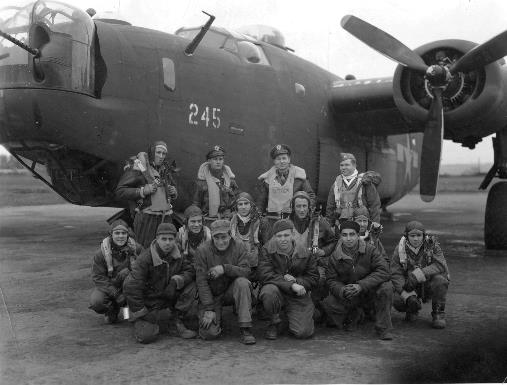
 On the 6th of March, we took off for Berlin. This was an interesting day. First, these other groups resented us leading them. Here was this crew coming from somewhere else and taking over as lead crew. Even though they put their command pilot with us, they still resented this outside crew coming in to lead them. I don’t know who made this decision, but they put us in as deputy lead for the Second Air Division. We were flying off the right wing of the lead plane. The command pilot was in the lead plane, but we had instructions that if the conditions were going to be undercast when we got to Berlin, they would give us the green light to take over the lead and we were to bomb on radar. The reason for this was that they wanted their plane to be in the lead and we were just there for that emergency condition. We were just approaching Berlin when we got the green light to take over the lead. The plan was that, if we had to take over the lead in an undercast situation when the other bombers couldn’t use their Norden bomb sights, we were to zero in on the target, open the bomb bay doors, and bomb. The other planes opened their doors when we did and then bombed when they saw us release.
 To me it was quite obvious it was clear over Berlin. It had been undercast just before at the initial point. We didn’t have much time to take over the lead. You need to set up your automatic pilot and warm up the bomb sight. I told my bombardier, “I think it’s clear enough to bomb visually.” It would have taken fifteen minutes to get the bomb sight ready and get the gyros going to full speed. All the time, we were approaching Berlin. We had our bomb bay doors open, and our radio navigator said we were about right over the target. With radar, you have to use a lot of imagination and a lot of guessing. He said it’s time to drop the bombs. I told the bombardier, “Toggle the bombs” (drop the bombs). He couldn’t drop the bombs for some reason. I think he was just scared. He wasn’t my regular bombardier. I told Satterland, my co-pilot, “Salvo them!” Right between the pilot and co-pilot, there was a red handle that allowed you to salvo your bombs in an emergency. He did it, then we turned the lead back over to the lead ship. The flak over Berlin was really heavy. I still have a piece of the flak that broke the glass above my head and lodged in the seat behind me.
 It turned out we were the first B-24 over Berlin.
--Richard A. Larson, recalling a 1944 Eighth Air Force bombing mission over Germany
To my daughter, World War II seems like ancient history—something that happened after, say, the Trojan War and well before her birth. In terms of distance in time, it is for her as the Spanish-American War is for me.

To me, however, the Second World War seems recent enough if only because my father participated in it. He never spoke much about the war. Men of that generation tended not to. If he was haunted by demons because of what he experienced or what he saw or the friends he lost, we never really heard about it. He did have the piece of flak he mentioned in the quote above, and we were impressed by it. It made for an exciting story, like something we might see in the movies or on television, but it never really sank in that it was something that had actually trully happened and that he had come so close to winding up as one more casualty of that war. Sixty-eight of 750 B-24’s and B-17’s did not come back from that March 6 mission over Berlin. In the course of the war, the Eighth Air Force suffered some 26,000 casualties—accounting for half of all the Army Air Force casualties and exceeding the number of marine casualties in the Pacific theater. That was certainly more serious stuff than anything I was up to at the age of 24.

B-24 and crew
Richard A. Larson (rear left) and crew in front of their B-24 Liberator

If I was at all nervous about flying to Berlin a couple of weeks ago, mere hours after the terrorist attacks in Brussels, I only had to remind myself that I had it infinitely better than Dad did on his flight to Berlin.

Making my first visit to Berlin—or, for that matter, to Germany—was strange in that it was the first time in my life that I was in a place that I knew with total certainty that my father had bombed. That knowledge never left my consciousness during the entire visit. Every time (and there were many) that a placard or a person mentioned an important site that had suffered damage during World War II, the question ran through my mind, did Dad drop that one? I thought of the fear that civilians must have felt at the sound of the planes and the bombs. On the other hand, I knew that Dad and the other servicemen had to be pretty scared too. And, as we encountered the legacy of the many horrific atrocities of the Nazi regime, there was some satisfaction in knowing that Dad had played a part in ending it.

Berlin blackout poster
Poster admonishing Berliners to maintain the blackout
in the face of Allied bombing during World War II


Because the man I grew up with had participated in the war, I was also very conscious of how recent all those events were. In the grand scheme of things, World War II was just a moment ago. Centenary observances in Ireland these days are a frequent reminder that a scant century ago the country where I now live was caught up in an armed rebellion that was soon followed by a bloody civil war.

In fact, the more time passes, the more I find astounding that history seemed to pivot so dramatically after 1945. As Berlin’s marvelous museums teach us, European history and, indeed, all human history seem to consist of one war after another, punctuated by fitful and temporary periods of relative peace. Yet there has been no widespread conflagration on the scale of the world wars for nearly three-quarters of a century.

Has the human race (suddenly and quickly) evolved to the point where the only wars are now small regional ones? Or sporadic attacks against civilians by terrorists who hide in major cities? Have we really become so enlightened that we will never again see the devastation wrought by supposedly civilized nations like that which was launched in 1914 and 1939? Or is it the case, as I sometimes fear, that because people are now living longer and thus generations endure longer, it just takes longer for new generations to forget—or never learn—the lessons of the past?

Tuesday, March 29, 2016

Between Past and Future

“Those who think the past predicts the future are condemned to pick the wrong stocks.”
Dilbert cartoonist Scott Adams
If I were clairvoyant, I probably would not have arranged to be passing—within a day and a half of the Brussels terrorist attacks—through airports in two European capitals and traveling on a capital city’s underground metro system.

Belgian embassy in Berlin
The Belgian embassy in Berlin on Friday

But that is how it worked out. The trip was booked and paid for, and there was no rational reason to cancel. Besides, I could reassure myself with Jeffrey Goldberg’s piece in The Atlantic on President Obama’s approach to foreign policy. “Obama frequently reminds his staff,” wrote Goldberg, “that terrorism takes far fewer lives in America than handguns, car accidents, and falls in bathtubs do.”

And of course the president is absolutely correct. Moreover, this kind of statistical comparison shows that he is taking the kind of analytical approach that people like me appreciate and which many people, even if they do not happen to be very analytical, find very intelligent-sounding. My family and I went to Berlin the very day after the Brussels outrage because we knew it was safer than staying at home and having a bath—even though the president was actually talking about the terrorism threat within the United States.

So why does the president keep getting so much criticism for not seeming to take the terror threat seriously enough? Because people are understandably unnerved. Sometimes people need to hear some reassurance that those in charge have a clue about what is scaring them—rather than reading remarks that sound like criticism of their intelligence. And we know that President Obama understands this. How do we know? Because when a young male African-American is tragically and unjustly shot by a police officer, we never read that he has told someone that a young male African-American is 40 times less likely to be killed by a police officer than by a fellow young male African-American. He knows that such a statistic, regardless of how true, is irrelevant to a community that feels under threat. Unfortunately, he does not seem to have a similar empathy when it comes to those who have serious worries about the terrorist threat.

There is another problem with the president’s statistical approach to the risk of terrorism. Quoting historical odds supposes that terrorist acts occur with some constancy over time. The various radical islamist movements are, in their own minds, conducting a war, and wars have phases and they accelerate over time. The historical rate of terrorist attacks is no more a predictor of the rate of future attacks than is the historical rate of change in the price of your favorite company’s stock an indication of how it will perform in the future. People know this intuitively, and as a result their internal emotional analysis of the threat may well be more realistic than the president’s apparent assumption that past performance is somehow a guarantee of future results.

In the grand historical scheme of things, a visit to Berlin certainly helps put things in some sort of perspective. The city’s wonderful museums do a great job of refreshing the memory about Germany’s long history of expanding and shrinking empire, its fall into darkness eight decades ago and its four decades as a nation divided between Western liberalism and Soviet communism. It reminds us that balances of power and even national borders can suddenly and violently shift, that sometimes we do not really perceive a looming threat until it is too late and that sometimes the threat arises within our own midst.

I expect to have more reflections on Berlin—this being my first visit not only to that great city but to Germany—as well as the centenary of Ireland’s 1916 Easter Rising, which is yet another reminder of how drastically things can change in a relatively short space of time.

Friday, February 5, 2016

The Bern and Hill Show

Cooper: “One of the things that Senator Sanders points to, and a lot of your critics point to, is you made three speeches for Goldman Sachs, you were paid $675,000 for three speeches. Was that an error in judgment?”
Clinton: “I made speeches to lots of groups. I told them what I thought. I answered questions.”
Cooper: “But did you have to be paid $675,000?”
Clinton: “Well, I don’t know. That’s what they offered so…”
—Anderson Cooper and Hillary Clinton at a CNN Town Hall on Wednesday

 “As for Mrs. Clinton, look, after all she’s done for us and after all she’s suffered on our behalf, she feels she’s owed the presidency, and who could possibly disagree? Her life is meaningless if she doesn’t get at least a shot, and one can only sympathize. Unless you think, as I do, that people should be distrusted, who are running for therapeutic reasons. Because the presidency doesn’t calm those demons, as her husband has already proved.”
—Author/essayist Christopher Hitchens (1949-2011)
After watching last night’s Democratic debate in New Hampshire, my impressions of the two remaining candidates is by now pretty much cast in cement—and, I have to assume, so it is for most voters.

Early on in the campaigning, a friend in Seattle declared that she expected to vote for Hillary Clinton in November but that, until the nomination was actually settled, she was going to be giving her full support to Bernie Sanders. Another Seattle friend told me more recently that she was convinced that her man Bernie was going to go all the way. While I do not share their enthusiasm, I certainly understand it.

If someone put a gun to my head and forced me to choose between Clinton and Sanders to be the next president, I would have to reluctantly elect the former first lady, senator and secretary of state. Her experience and pragmatism give her the better chance to succeed as president. But, looking at the two candidates purely as people, I like Sanders a whole lot more. In debates he engages. He listens to questions and answers them. He does not worry about double-checking his answer to avoid a gaffe. His gaffe-avoidance strategy is to simply tell the truth and to say what he really thinks. His style is that of the guy who has had countless informal debates over things he believes passionately in numerous kitchens and living rooms. Clinton, in contrast, is the kind of speaker who has clearly honed her rhetorical skills by addressing large audiences. She is the type of politician who surrounds herself with acolytes and admirers. When she answers a debate question, you can almost see her filing through the index cards in her brain for the stored paragraph that will suit best.

When it comes to economics and foreign policy, Sanders’s world view is on the other side of the universe from my own. But that does not mean I disagree with him on everything. I have been fascinated by the back-and-forth between him and Clinton through each of the debates about the Glass-Steagall Act. Invoking the name of legislation is always a sure-fire way to make an audience doze off, but this is one law that is really key to the U.S.’s economic problems. This is the Depression-era law that erected a firewall between a bank’s savings business and its investment business. It wisely kept ordinary bank customers from being put at risk by a bank’s shenanigans with perilous financial adventurism. It also limited the consolidation that could go on in the financial sector. It was unwisely repealed during the heady days of a booming economy in 1999 by Republican-sponsored legislation which was signed into law by Bill Clinton. You can draw a straight line from the repeal of Glass-Steagall to the financial crisis of 2007-2008 which popularized the term “too big to fail” and led to massive taxpayer-funded bailouts.

Sanders argues correctly that repealing Glass-Steagall was a mistake and that it should be reenacted. Clinton hedges but she is clearly against reenactment. No wonder the big Wall Street players are pouring cash into her campaign. Her way of establishing her anti-Wall Street credentials is to tout the Dodd-Frank Act as some sort of victory for the little guy. Dodd-Frank merely adds additional layers of reporting requirements to financial institutions that are beyond the resources of small and medium-sized companies. The result has been a massive consolidation in the industry, as smaller banks go out of business or else merge with larger ones. Congress couldn’t have done a better job if it had deliberately set out to make banks too big to fail. And politicians like Clinton almost cannot wait to be in a position to do those guys a favor down the road—even while they use them as whipping boys in their campaign speeches.

To my surprise this business with Clinton’s email server actually seems to be getting serious. Tellingly, when Sanders was given the opportunity to defend her last night, he merely demurred on the basis that there was a process going on. That process is an FBI investigation, and until recently the betting was against the Justice Department taking action because it would look like meddling in the presidential campaign. But now it’s gotten to the point where it would nearly look like meddling if Justice does not taken action.

Clinton’s defense on this problem last night was a perfect example of why people like me don’t trust her—even while admiring her. She pointed out that other (Republican) secretaries of state have had private email accounts. While that is true, it is also completely irrelevant, and it’s an insult to our intelligence that she figures people cannot see that. The fact is that she used a private email account exclusively, but even that is not the salient point. The problem is that she had her own email server—in her own house. It did not have the protection of government security, and we now know that it held a lot of highly sensitive information. It is not an issue of “over-classification” as she keeps saying. Either she did not understand what a risk she was taking with national security—or she simply didn’t care. It was apparently more important that the public never see her communications that melded government business with her personal affairs and Clinton Foundation donor service.

Her home brew server may not be the most egregious or arrogant or illegal act committed by any politician. But the way she has handled it in the campaign certainly exemplifies what is unappealing about Hillary Clinton as a potential president. Even while she is pandering for our votes, she looks out at us and thinks we are idiots.

Wednesday, January 20, 2016

Finding Fault

“First of all, we waited too long. We let the Islamic state build up its money, capability and strength and weapons while it was still in Syria. Then when [ISIS] moved into Iraq, the Sunni Muslims didn’t object to their being there and about a third of the territory in Iraq was abandoned.”
—Former President Jimmy Carter, October 7 in an interview with the Fort Worth Star-Telegram
There is a refrain that I am hearing repeated more and more. It is the notion that the so-called Islamic State, or ISIS, was virtually created whole-cloth by blundering American foreign and military policy.

To be sure, this is now a standard Democratic talking point. It is trotted out as a defense whenever Republicans criticize the Obama administration as being weak and feckless in the Middle East. And, of course, Republicans have their own contrasting talking point—that ISIS flourished in (if was not actually spawned by) a vacuum created by President Obama’s rush to get out of Iraq.

But it is not just political hacks who keep repeating the line about ISIS being a virtual creation of the Bush administration. It is a common theme among journalists and analysts in the UK and Ireland and undoubtedly many other countries. And also among many U.S. writers. Journalist/author Robin Wright could be heard on NPR’s Fresh Air a couple of weeks ago saying that the invasion of Iraq was the worst foreign policy blunder in U.S. history. In his book Black Flags: The Rise of ISIS, Washington Post reporter Joby Warrick (as one book review sums up) “blames the American invasion of Iraq in 2003 as the single most pivotal factor in the organization’s creation.” Warrick’s narrative focuses largely on Jordanian Abu Musab al Zarqawi who, he says, founded (before the Iraq invasion, by the way) the group that would evolve into ISIS.

The idea that really bad actors and bad events in the Middle East are the direct result of American (or, more generally, Western) actions has a long history. For generations academics and many journalists have laid the blame for this conflict or that war at the feet of imperial legacy. And of course historical events like the crusades and colonization cannot help but have had a major impact on the history of region. (Interestingly, however, westerners who lecture guiltily about the crusades never seem to bring up the fact that in the eighth century Muslims conquered all of Europe’s Iberian Peninsula and advanced into France as far as Poitiers and Tours.)

The mindset that every major thing that happens in the Middle East is caused by Western interloping seems somehow, well, western-centric and dismissive of other peoples as having a hand in their own destinies. Saying ISIS was “created” by America frankly makes it sound like some sort of comic book super-villain who starts out as a perfectly normal guy but suddenly turns evil because he fell into a vat of chemicals.

The most interesting take I have seen so far on the genesis of ISIS was in a Washington Post piece last April by Liz Sly, the paper’s Beirut bureau chief. Her sources were telling her that, while ISIS’s fighting and dying is done by recruits from many countries, the organization is run by Iraqis who are former Baathist military officers. In the end, her thrust was the same as Wright’s and Warrick’s—that the U.S. is at fault. But, according to Sly, the fault was specifically in disbanding Saddam Hussein’s army and turning all those armed men loose with no prospects in the new Shi’ite-run Iraq. This analysis is actually pretty hard to refute. Even people who defend the invasion of Iraq concede that the occupation was not well handled. But while many critics insisted that the very act of occupation was the cardinal sin, does it not seem that the problem of ISIS was caused by not having a more effective occupation? The Shi’ite majority had no interest in integrating the Sunni minority that had ruled over them under the brutal Saddam. If the U.S. had exerted more of its authority as the occupying power (instead of leaving Nouri al-Maliki and Jalal Talabani to their own devices) to ensure a more inclusive system of government, might it not have helped? In other words, perhaps the problem was not U.S. meddling but, rather, not enough U.S. meddling. After all, Iraq was largely peaceful (at least relative to its recent history) when Barack Obama took office in 2009. In fact, it is was so much so that (and it’s hard to remember this now) the president and Vice-President Joe Biden, in talking about the U.S. withdrawal, both touted Iraq as an American achievement.

What is interesting about Sly’s article is her description of how seamlessly Baathism mutated into a radical Islamic movement. “By the time U.S. troops invaded in 2003,” she wrote, “Hussein had begun to tilt toward a more religious approach to governance, making the transition from Baathist to Islamist ideology less improbable for some of the disenfranchised Iraqi officers.” She also noted that the regime brutality was ever increasing, thus presaging ISIS’s savagery. “In the last two years of Hussein’s rule,” she noted, “a campaign of beheadings, mainly targeting women suspected of prostitution and carried out by his elite Fedayeen unit, killed more than 200 people, human rights groups reported at the time.”

While this isn’t the point Sly was making, her article gives the unmistakable impression that Baathism under Saddam was quite possibly on track to evolve into something like the Islamic State even without American interference. After all, well before the invasion of Iraq, Saddam had invaded and fought wars with neighboring countries and had committed atrocities (including the use of weapons of mass destruction) on his own people. There is absolutely no reason to believe that the situation in the region would be hunky-dory today if the U.S. had kept all its troops at home during the past decade and a half. And you cannot even be sure that the region’s bad actors would have left the West alone absent the Iraq invasion. After all, the 9/11 attacks happened before the Iraq invasion.

Of course, there is no way we can ever know what might have (or might not have) occurred if things had happened differently. And that, ultimately, is the problem with the easy dismissal of complicated developments abroad as being entirely the result of the actions of just one of many actors in a complex world.